现代c++编程
#include <print>

int main() {
    std::println("Hello world!");
}
编译
c++ -std=c++23 -Wall -Werror first.cpp -o first
运行
./first
编译和运行
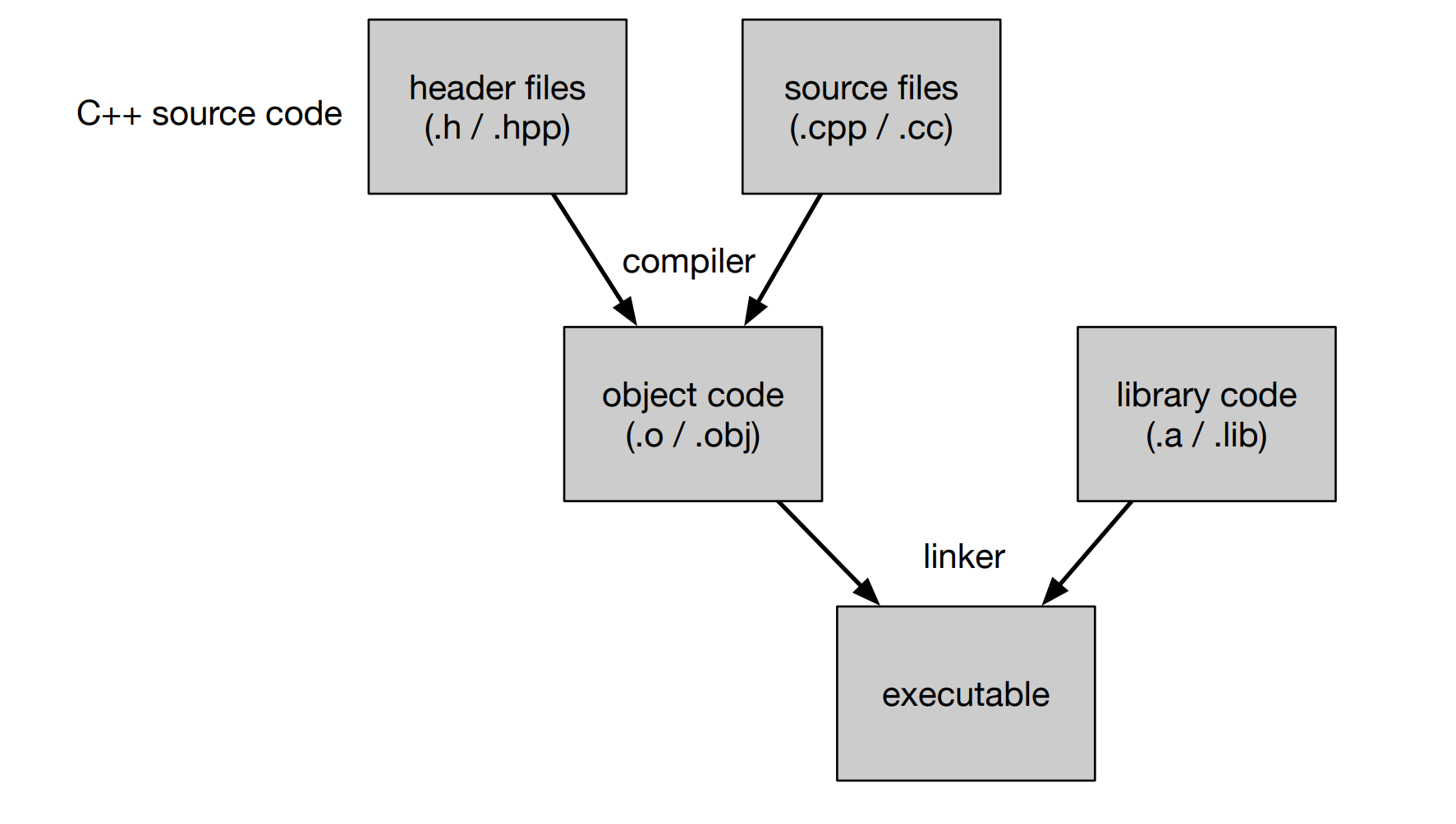
首先被编译成object code 然后linker会link一些库最后编程可执行文件
- translation unit: input of compiler
- object code is the output of compiler
#includeis done vis the preprocessor (literally included = long compilation time)- compiler uses the declaration to know the signature of object, not resolve external thing
- linker check these symbols
头文件和源文件
- declarations in header files
- definitions in source files
ODR
- all object have at most one definition in any translation unit
- all object that are used have exactly one definitions
Head guards
#ifdef H_HEAD
#define H_HEAD

#endif
或者
#pragma once
modules (doesn't work yet)
定义module
export module sayHello;

import <print>;

export void sayHello() {
    std::println("Hello World!");
}
使用
import sayHello;

int main() {
    sayHello();
}
CMake
CMakeLists.txt
cmake_minimum_required(VERSION 3.27)
project(exampleProject LANGUAGES CXX)

add_executable(exampleProject main.cpp)
cmake_minimum_requiredrequire at least a versionprojectdefine a project with nameadd_executablebuild executable with name and source fileadd_librarydefine a librarytarget_include_directories(myProgram PUBLIC inc)where to look for include files for the target “myProgram”target_link_libraries(myProgram PUBLIC myLibrary)which libraries to add to target “myProgram”
C++ Basic
Types and built-in types
- static type safety
a program that violates type safety will not compile, compiler report violation
- dynamic type safety
if a program violates type safety it will be detected at run-time
C++ is neither statically nor dynamically type safe!
TYPE variablename{initializer};
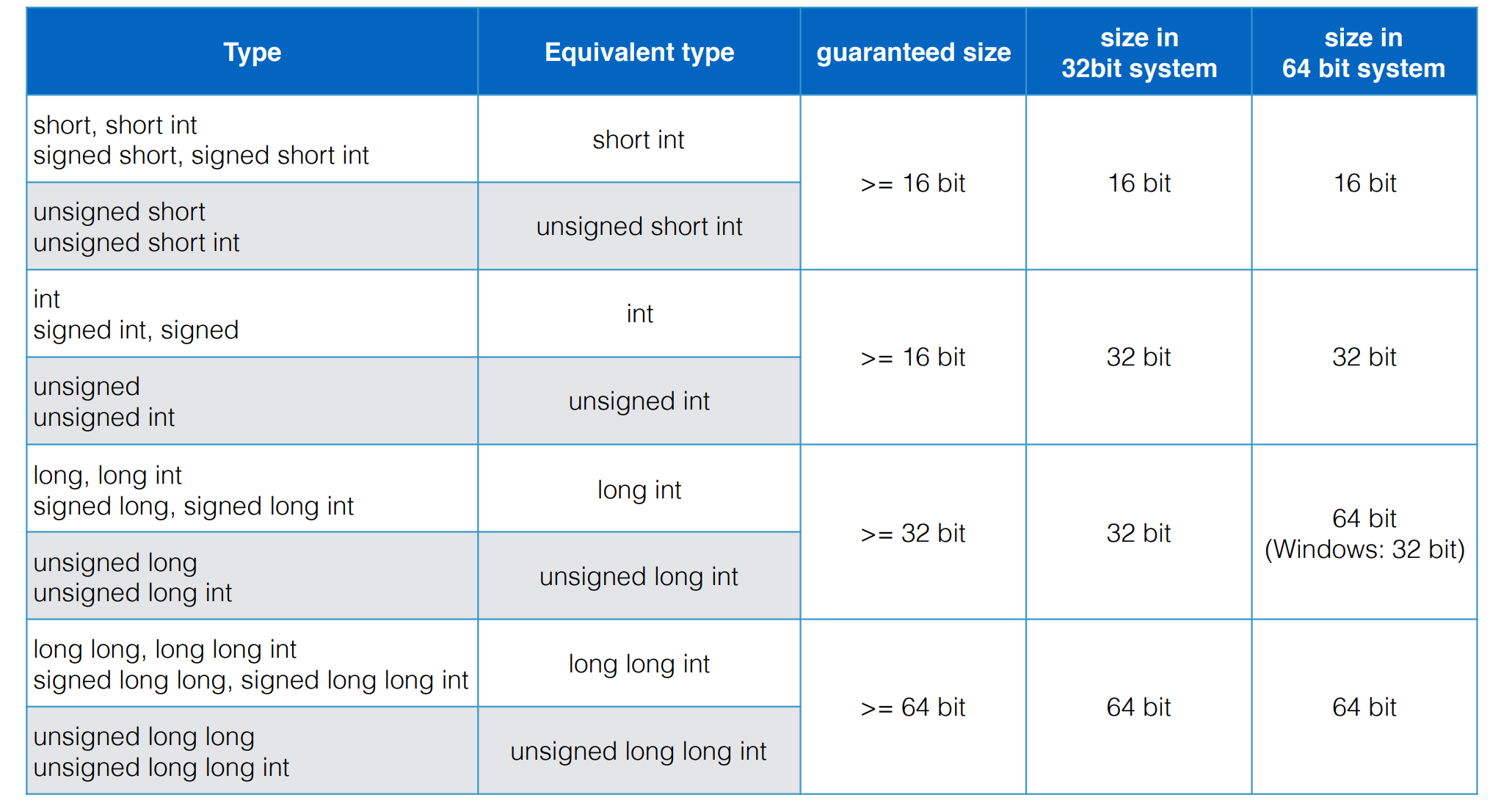
Integer literal
- decimal:
42 - octal(base 8):
052 - hex:
0x42 1'000'000'000'000ull
careful 0xffff maybe -1 or 65536
cout << 0xffff << endl; // 65536
std::ptrdiff_t
const std::size_t N = 10;
int* a = new int[N];
int* end = a + N;
for (std::ptrdiff_t i = N; i > 0; --i)
    std::cout << (*(end - i) = i) << ' ';
std::cout << '\n';
delete[] a;
- double (64bit): approx. 15 digits
-
long double (64-128bit): approx. 19 digits
1.0l -
float128_t
Initialization
safe: variableName{}
unsafe: variableName = or variableName()
the unsafe version may do (silent) implicit conversions
local variables are usually not default-initialized, this can lead to undefined behavior when accessing an uninitialized variable
const
const T
a const object is considered immutable and cannot be modified
extern int errorNumber; declare, no definition
using Cmplx = std::complex;
float sqrt(float); declares the function sqrt, taking a float as argument, returning a float, no definition!
std::vector<int> v1{99}; // v1 is a vector of 1 element
// with value 99
std::vector<int> v2(99); // v2 is a vector of 99 elemen

std::vector<std::string> v1{"hello"};
// v1 is a vector with 1 element with value "hello"
std::vector<std::string> v2("hello");
// ERROR: no constructor of vector accepts a string literal

std::complex<double> z1(0, 1); // uses constructor
std::complex<double> z2{}; // uses constructor,
// default value {0,0}
std::complex<double> z3(); // function declaration!
std::vector<double> v1{10, 3.3}; // list constructor
std::vector<double> v2(10, 3.3); // constructor, v has 10 elements set to 3.3

int x{}; // x == 0
double d{}; // d == 0.0

std::vector<int> v{}; // v is the empty vector
std::string s{}; // s == ""
Type Alias
typedef int myNewInt; // equivalent to using myNewInt = int
Scope
int x{0}; // global x

void f1(int y) { // y local to function f1
    int x; // local x that hides global x
    x = 1; // assign to local x
    {
        int x; // hides the first local x
        x = 2; // assign to second local x
    }
    x = 3; // assign to first local x
    y = 2; // assign to local y
    ::x = 4; // assign to global x
}

int y = x; // assigns global x to y (also global)
Lifetime
The lifetime of an object
- starts when its constructor completes
- ends when its destructor starts executing
using an object outside its lifetime leads to undefined behavior!
storage duration: which begins when its memory is allocated and ends when its memory is deallocated, the lifetime of an object never exceeds its storage duration
-
automaticallocated at beginning of scope, deallocated when it goes out of scope -
static: allocated when program starts, lives until end of program -
dynamic: allocation and deallocation is handled manually (see later) (usingnew, delete) -
thread-local: allocated when thread starts, deallocated automatically when thread ends; each thread gets its own copy
Auto
#include <print>
#include <memory>
#include <boost/type_index.hpp>
using namespace boost::typeindex;

int main() {
    auto a = {13, 14};
    auto u{std::make_unique<int>()};
    std::println("Type a: {}", type_id_with_cvr<decltype(a)>().pretty_name());
    std::println("Type u: {}", type_id_with_cvr<decltype(u)>().pretty_name());
}
Array and Vector
#include <array>
#include <print>

int main() {
    std::array<int, 10> a{}; // array of 10 int, default initialized
    std::array<float, 3> b{0.0, 1.1, 2.2}; // array of 3 float

    for (unsigned i = 0; i < a.size(); ++i)
        a[i] = i + 1; // no bounds checking

    for (auto i : b) // loop over all elements of b
        std::println("{}", i);

    a.at(11) = 5; // run-time error: out_of_range exception
}
- Do not use:
int a[10] = {};
float b[3] = {0.0, 1.1, 2.2};
Not-fixed size array: vector
Loop
#include <print>
#include <format>
#include <vector>

int main() {
    std::vector<int> a{1, 2, 3, 4, 5}; // initializer list

    for (unsigned i = 0; i < 5; ++i) // regular for loop
        a.push_back(i + 10);

    for (const auto& e : a) // range for loop
        std::print("{}, ", e);
    std::println("");

    for (auto i : {47, 11, 3}) // range for loop
        std::print("{}, ", i);
}
lvalue and rvalue
lvalue
- lvalues that refer to the identity of an object, modifiable lvalues can be used on left-hand side of assignment
rvalue
- rvalues that refer to the value of an object, lvalues and rvalues can be used on right-hand side of assignment
Increment
- prefix variants increment/decrement the value of an object and return a reference to the result
- postfix variants create a copy of an object, increment/decrement the value of the original object, and return the unchanged copy
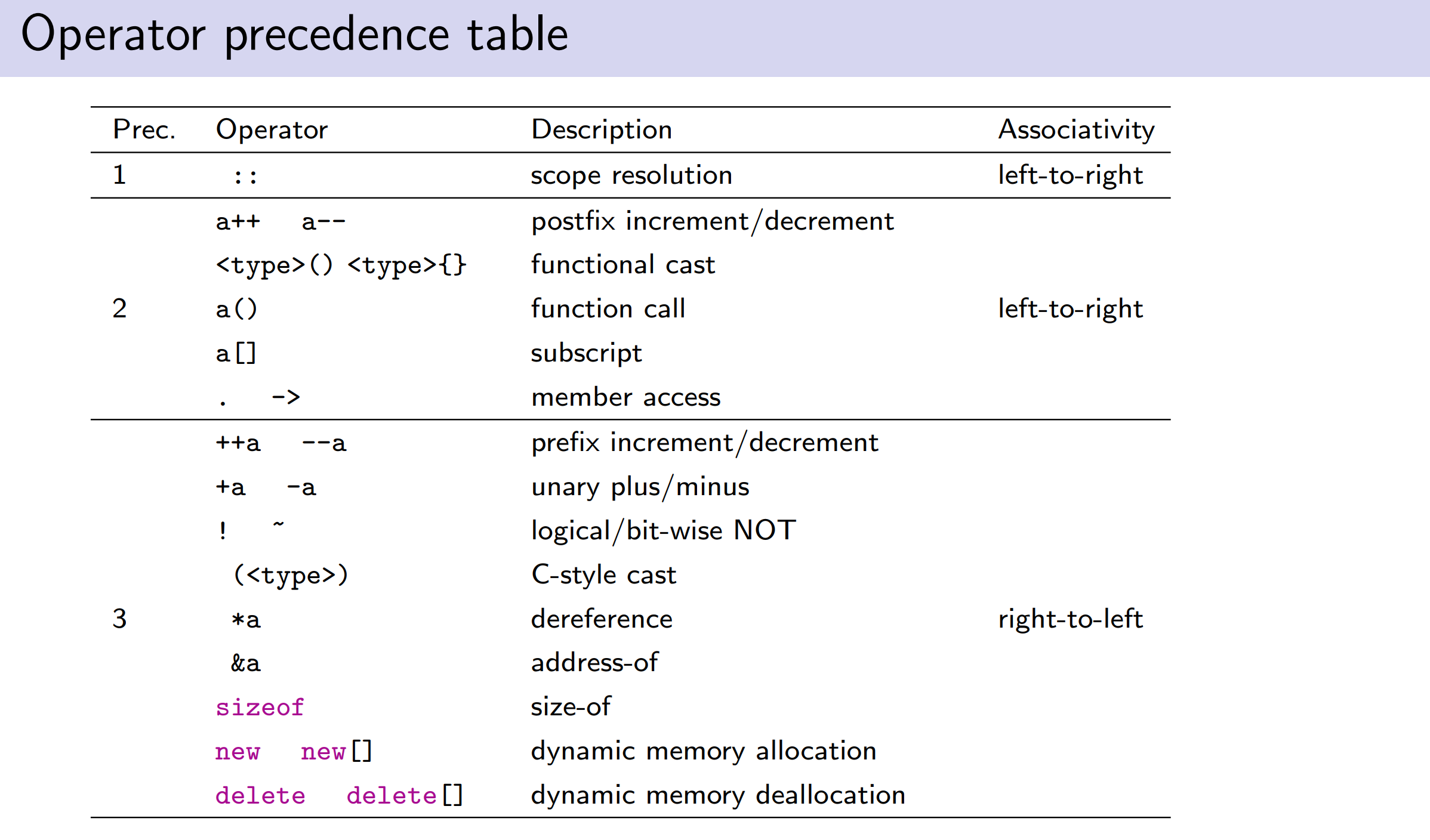
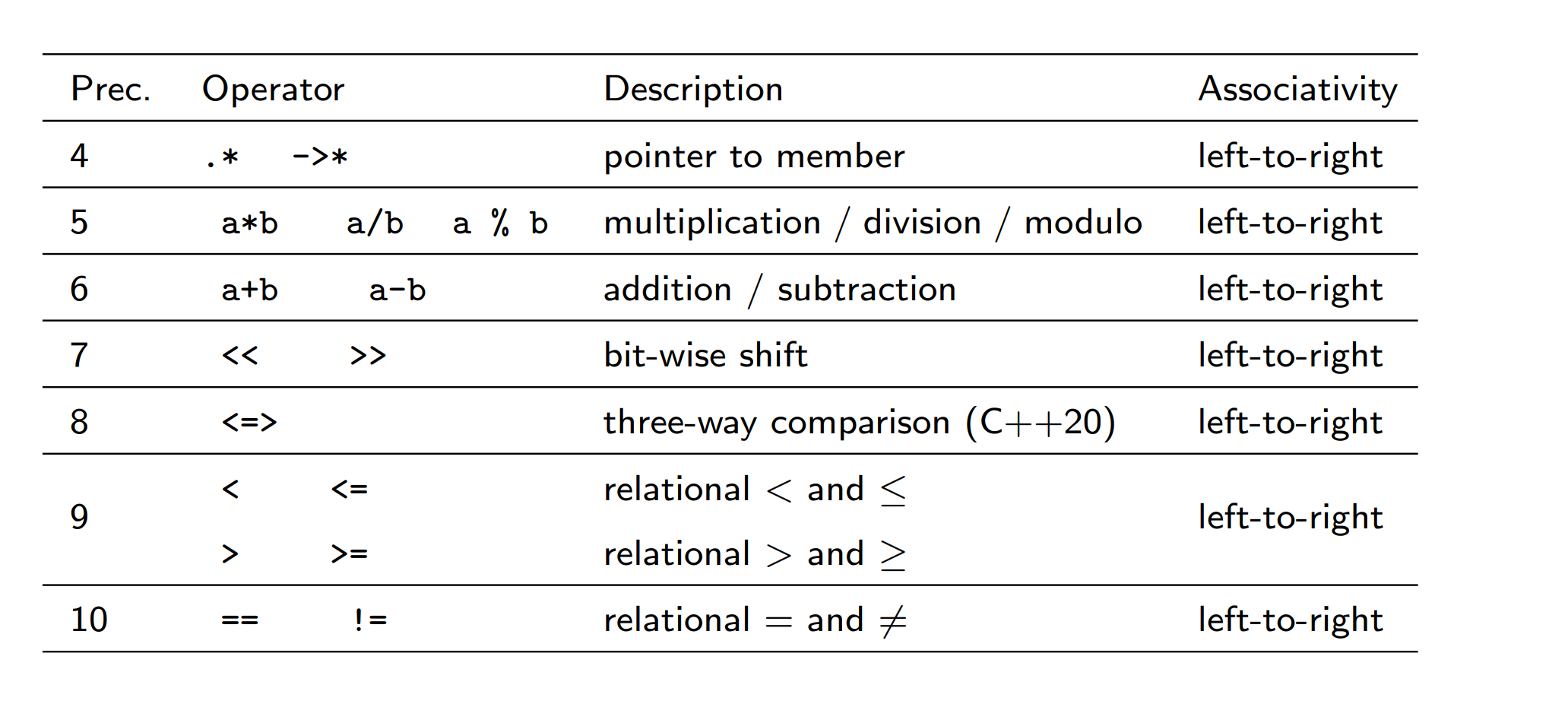
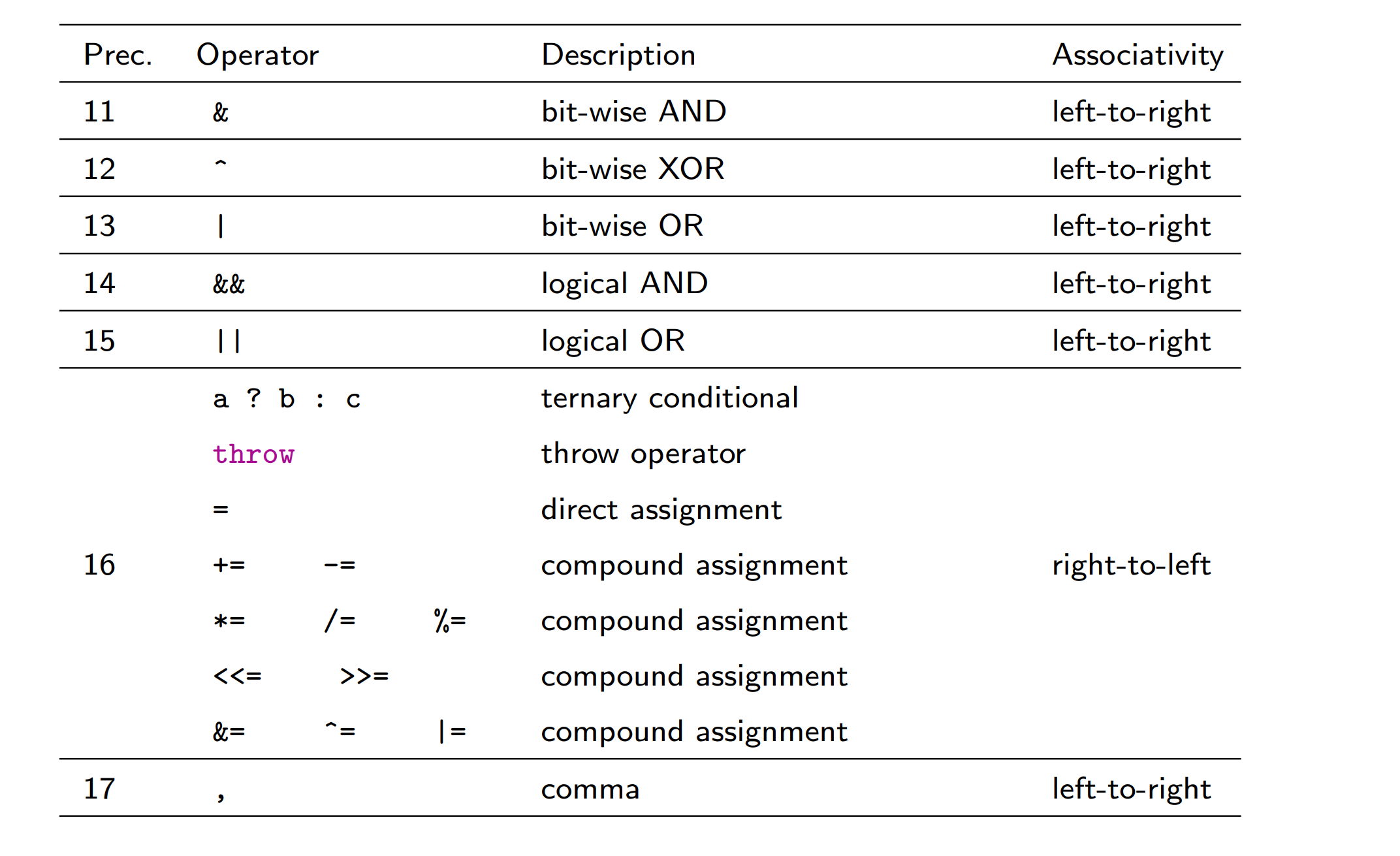
Precedence
-
operators with higher precedence bind tighter than operators with lower precedence
-
operators with equal precedence are bound in the direction of their associativity
if, switch
if (auto value{computeValue()}; value < 42) {
    // do something
}
else {
    // do something else
}

switch (computeValue()) {
    case 21:
        // do something if computeValue() was 21
        break;
    case 42:
        // do something if computeValue() was 42
        break;
    default:
        // do something if computeValue() was != 21 and != 42
        break;
}
Reference
- LReference
&declarator - RReference
&&declarator
Refences are special
- there are no references to void
- references are immutable (although the referenced object can be mutable)
- references are not objects, i.e. they do not necessarily occupy storage
int &m{i}; // valid
int& n{i}; // also valid, by convention
- a reference to type T must be initialized to refer to a valid object
there are exceptions:function parameter declarations,function return type declarations,when using extern modifier
int global0{0};
int global1{0};

int& foo(unsigned which) {
    if (!which)
        return global0;
    else
        return global1;
}

int main() {
    foo(0) = 42; // global0 == 42
    foo(1) = 14; // global1 == 14
}
Rvalue references cannot (directly) bind to lvalues:
int i{10};
int&& j{i}; // ERROR: cannot bind rvalue ref to lvalue
int&& k{42}; // OK
Rvalue references can extend the lifetime of temporary objects:
int i{10};
int j{32};

int&& k{i + j}; // k == 42
k += 42; // k == 84
Overload resolution (see later) allows to distinguish between lvalues and rvalues:
void foo(int& x);
void foo(const int& x);
void foo(int&& x);

int& bar();
int baz();

int main() {
    int i{42};
    const int j{84};

    foo(i); // calls foo(int&)
    foo(j); // calls foo(const int&)
    foo(123); // calls foo(int&&)

    foo(bar()); // calls foo(int&)
    foo(baz()); // calls foo(int&&)
}
references themselves cannot be const, however, the reference type can be const
Dangling references
int& foo() {
int i{42};
    return i; // MISTAKE: returns dangling reference!
}
Converting
static cast:
static_cast< new_type > ( expression )
- new_type must have same const-ness as the type of expression
Do not use: (const_cast, reinterpret_cast, C-style cast: (new_type) expression)
int sum(int a, int b);
double sum(double a, double b);

int main() {
    int a{42};
    double b{3.14};

    double x{sum(a, b)}; // ERROR: ambiguous
    double y{sum(static_cast<double>(a), b)}; // OK
    int z{sum(a, static_cast<int>(b))}; // OK
}
Function
C++ also allows a trailing return type:
auto foo() -> int;

template <typename T, typename U>
auto sum(const T& x, const U& y) -> decltype(x+y);
Return multiple
std::pair<int, std::string> foo() {
    return std::make_pair(17, "C++");
}

std::tuple<int, int, float> bar() {
    return std::make_tuple(1, 2, 3.0);
}
Structured Binding
std::map<std::string, int> myMap; // map with strings as keys
// ... fill the map ...

// iterate over the container using range-for loop
for (const auto& [key, value] : myMap)
std::println("{}: {}", key, value);
you can also bind struct members or std::array entries:
struct myStruct { int a{1}; int b{2}; };
auto [x, y] = myStruct{}; // x, y are int, x == 1, y == 2

std::array<int, 3> myArray{47, 11, 9};
auto [i, j, k] = myArray; // i == 47, j == 11, k == 9
specifying the return type for multiple values can be annoying:
auto bar() {
    return std::make_tuple(1, 2, 3.0);
}
Parameter passing
- in parameter
void f1(const std::string& s); // OK, pass by const reference
void f2(std::string s); // potentially expensive
void f3(int x); // OK, cheap
void f4(const int& x); // not good, unnecessary overhead
in-outparameter
void update(Record& r); // assume that update writes to r
outparameter
return them
Overloading
the compiler automatically resolves the overloads in the current scope and calls the best match
void f(int); // a function called f, taking an int
void f(double); // another function f, taking a double
Criteria
- exact match. no or only trivial conversions, e.g. T to const T)
- match using promotions (e.g. bool to int, char to int, or float to double)
- match using standard conversions (e.g. int to double, double to int, or int to unsigned int)
- match using user-defined conversions
- match using ellipsis
void print(int);
void print(double);
void print(long);
void print(char);

void f(char c, int i, short s, float f) {
    print(c); // exact match: print(char)
    print(i); // exact match: print(int)
    print(s); // integral promotion: print(int)
    print(f); // float to double promotion: print(double)

    print('a'); // exact match: print(char)
    print(49); // exact match: print(int)
    print(0); // exact match: print(int)
    print(0L); // exact match: print(long)
}

using complex = std::complex<double>;

int pow(int, int);
double pow(double, double);
complex pow(double, complex);
complex pow(complex, int);
complex pow(complex, complex);

void h(complex z) {
    auto i = pow(2, 2); // invokes pow(int, int)
    auto d = pow(2.0, 2.0); // invokes pow(double, double)
    auto z2 = pow(2, z); // invokes pow(double, complex)
    auto z3 = pow(z, 2); // invokes pow(complex, int)
    auto z4 = pow(z, z); // invokes pow(complex, complex)
    auto e = pow(2.0, 2); // ERROR: ambiguous
}
Functors
Functions are not objects in C++
- they cannot be passed as parameters
- they cannot have state
However, a type T can be a function object (or functor), if:
- T is an object
- T defines
operator()
struct Adder {
    int value{1};

    int operator() (int param) {
        return param + value;
    }
};

int main() {
    Adder adder;
    adder(1); // 6
}
std::function is a wrapper for all callable targets
caution: can incur a slight overhead in both performance and memory
#include <functional>
int addFunc(int a) { return a + 3; }

int main() {
    std::function adder{addFunc};
    int a{adder(5)}; // a == 8

    // alternatively specifying the function type:
    std::function<int(int)> adder2{addFunc};
}
other example
#include <functional>
#include <iostream>

void printNum(int i) { std::println("{}", i); }

struct PrintNum {
    void operator() (int i) { std::println("{}", i); }
};

int main() {
    // store a function
    std::function f_printNum{printNum};
    f_printNum(-47);

    // store the functor
    std::function f_PrintNum{PrintNum{}};
    f_PrintNum(11);

    // fix the function parameter using std::bind
    std::function<void()> f_leet{std::bind(printNum, 31337)};
    f_leet();
}
Lambda
Lambda expressions are a simplified notation for anonymous function objects
std::find_if(container.begin(), container.end(),
    [](int val) { return 1 < val && val < 10; }
);
- the function object created by the lambda expression is called closure
- the closure can hold copies or references of captured variables
[ capture_list ] ( param_list ) -> return_type { body }
-
capture_list specifies the variables of the environment to be captured in the closure
-
return_type specifies the return type; it is optional!
- if the param_list is empty, it can be omitted
Storing lambda
Lambda expressions can be stored in variables:
auto lambda = [](int a, int b) { return a + b; };
std::function func = [](int a, int b) { return a + b; };
std::function<int(int, int)> func2 =
    [](int a, int b) { return a + b; };

std::println("{}", lambda(2, 3)); // outputs 5
- the type of a lambda expression is not defined, no two lambdas have the same type (even if they are identical otherwise)
auto myFunc(bool first) { // ERROR: ambiguous return type
    if (first)
        return []() { return 42; };
    else
        return []() { return 42; };
}
Capture
- all capture: by copy
=, by reference&
void f() {
    int i{42};

    auto lambda1 = [i]() { return i + 42; };
    auto lambda2 = [&i]() { return i + 42; };

    i = 0;

    int a = lambda1(); // a == 84
    int b = lambda2(); // b == 42
}
Exception
#include <stdexcept>

void foo(int i) {
    if (i == 42)
        throw 42;

    throw std::logic_error("What is the meaning of life?");
}
- when an exception is thrown, C++ performs stack unwinding
ensures proper clean up of objects with automatic storage duration
#include <exception>
include <iostream>

void bar() {
    try {
        foo(42);
    } catch (int i) {
        /* handle the exception somehow */
    } catch (const std::exception& e) {
        std::cerr << e.what() << "\n";
        /* handle the exception somehow */
    }
}
No except
int myFunction() noexcept; // may not throw an exception
- exceptions should be used rarely, main use case: establishing class invariants
- exceptions should not be used for control flow!
- some functions must not throw exceptions,
- destructors,move constructors and assignment operators
expected
std::expected<T,E> stores either a value of type T or an error of type E
has_value()checks if the expected value is therevalue()or*accesses the expected valueerror()returns the unexpected value-
monadic operations are also supported, such as
and_then()oror_else() -
performance guarantee: no dynamic memory allocation takes place
enum class parse_error { invalid_input };

auto parse_number(std::string_view str) -> std::expected<double, parse_error> {
    if (str.empty())
        return std::unexpected(parse_error::invalid_input);
    // do actual parsing ...
    return 0.0;
}

int main() {
    auto process = [](std::string_view str) {
        if (const auto num = parse_number(str); num.has_value())
            std::println("value: {}", *num);
        else if (num.error() == parse_error::invalid_input)
            std::println("error: invalid input");
    };

    for (auto s : {"42", ""})
        process(s);
}
std::expectedis well suited for more regular errors, such as errors in parsing- exception handling is well suited for the rare failures you cannot do much about at the called function (e.g. out of memory)
STL
optional
encapsulates a value that might or might not exist
std::optional<std::string> mightFail(int arg) {
    if (arg == 0)
        return std::optional<std::string>("zero");
    else if (arg == 1)
        return "one"; // equivalent to the case above
    else if (arg < 7)
        return std::make_optional<std::string>("less than 7");
    else
        return std::nullopt; // alternatively: return {};
}

mightFail(3).value(); // "less than 7"
mightFail(8).value(); // throws std::bad_optional_access

*mightFail(3); // "less than 7"
mightFail(6)->size(); // 11
mightFail(7)->empty(); // undefined behavior
check value
mightFail(3).has_value(); // true
mightFail(8).has_value(); // false

auto opt5 = mightFail(5);
if (opt5) // contextual conversion to bool
opt5->size(); // 11
default
mightFail(42).value_or("default"); // "default"
reset
auto opt6 = mightFail(6);
opt6.has_value(); // true
opt6.reset(); // clears the value
opt6.has_value(); // false
monadic operations
and_then: if optional has value, returns result of provided function applied to the value, else empty optionalor_else: if optional has value, return optional itself, otherwise result of provided functiontransformif optional has value, return optional with transformed value, else empty optional
std::optional<int> foo() { /* ... */ }

void bar() {
    auto o = foo().or_else([]{ return std::optional{0}; })
        .and_then([](int n) -> std::optional<int> { return n+1; })
        .transform([](int n) { return n*2; })
        .value_or(-1337);
    std::println("{}", o);
}
Pair
std::pair<int, double> p1(123, 4.56);
p1.first; // == 123
p1.second; // == 4.56

auto p2 = std::make_pair(456, 1.23);
structure binding
auto t = std::make_tuple(123, 4.56);
auto [a, b] = t; // a is type int, b is type double

auto p = std::make_pair(4, 5);
auto& [x, y] = p; // x, y have type int&
x = 123; // p.first is now 123
variant
to store different alternative types in one object
std::variant<int, float> v;
v = 42; // v con    tains int
int i = std::get<int>(v); // i is 42

try {
    std::get<float>(v); // v contains int, not float; will throw
}
catch (const std::bad_variant_access& e) {
    std::cerr << e.what() << "\n";
}

v = 1.0f;
assert(std::holds_alternative<float>(v)); // succeeds
assert(std::holds_alternative<int>(v)); // fails
apply different
struct SampleVisitor {
    void operator() (int i) { std::println("int: {}", i); }
    void operator() (float f) { std::println("float: {}", f); }
    void operator() (const std::string& s) { std::println("string: {}", s); }
};

int main() {
    std::variant<int, float, std::string> v;
    v = 1.0f;
    std::visit(SampleVisitor{}, v);
    v = "Hello";
    std::visit(SampleVisitor{}, v);
    v = 7;
    std::visit(SampleVisitor{}, v);
}
without struct, with overload pattern
template<class... Ts> struct overload : Ts... { using Ts::operator()...; };

int main() {
    std::variant<int, float, std::string> v{"Goodbye"};

    std::visit( overload{
        [](int i) { std::println("int: {}", i); },
        [](float f) { std::println("float: {}", f); },
        [](const std::string& s) { std::println("string: {}", s); }
    }, v);
}
String
std::string encapsulates character sequences
- manages its own memory (RAII)
- guaranteed contiguous memory storage
- since C++20, it has constexpr constructors
alias for std::basic_string<char>
std::string s{"Hello World!");
std::cout << s.at(4) << s[6] << "\n"; // prints "oW"
at() is bounds checked, [] is not, both return a reference
s.at(4) = 'x';
s[6] = 'Y';
std::cout << s << "\n"; // prints "Hellx Yorld!"
append()and +=: appends another string or character+concatenates stringsfindreturns offset of the first occurrence of the substring, or the constantstd::string::nposif not found
string view
provides a read-only view on already existing strings
substr()creates another string view in \(O(1)\)
std::string s{"garbage garbage garbage interesting garbage"};

std::string sub = s.substr(24, 11); // with string: O(n)

std::string_view s_view{s}; // with string_view: O(1)
std::string_view sub_view = s_view.substr(24, 11); // O(1)

// in place operations:
s_view.remove_prefix(24); // O(1)
s_view.remove_suffix(s_view.size() - 11); // O(1)
in fuction
// useful for function calls
bool isEqNaive(std::string a, std::string b) { return a == b; }
bool isEqWithViews(std::string_view a, std::string_view b) { return a == b; }

isEqNaive("abc", "def"); // 2 allocations at runtime
isEqWithViews("abc", "def"); // no allocation at runtime
Container
Vector
emplace bace
struct ExpensiveToCopy {
    ExpensiveToCopy(int id, std::string comment)
        : id_{id}, comment_{comment} {}
    int id_;
    std::string comment_;
};

std::vector<ExpensiveToCopy> vec;

// expensive
ExpensiveToCopy e1(, "my comment 1");
vec.push_back(e1);

// beter
vec.push_back(std::move(e1));

// best
vec.emplace_back(2, "my comment 2");
// also works at any other position:
auto it = vec.begin(); ++it;
vec.emplace(it, 3, "my comment 3");
reserve
std::vector<int> vec;
vec.reserve(1000000); // allocate space for 1000000 elements
vec.capacity(); // == 1000000
vec.size(); // == 0 (no elements stored yet!)
fit
std::vector<int> vec;
vec.reserve(100);

for (int i = 0; i < 10; ++i)
vec.push_back(i);

// only needed a capacity of 10, free the space for the rest
vec.shrink_to_fit();
Other
std::arrayfor compile-time fixed-size arraysstd::dequeis a double-ended queuestd::listis a doubly-linked liststd::forward_listis a singly-linked liststd::queueprovides the typical queue interface, wrapping one of the sequence containers with appropriate functionsstd::stackprovides the typical stack interface, wrapping one of the sequence containers with appropriate functions (deque, vector, list)std::priority_queueprovides a typical priority interface, wrapping one of the sequence containers with random access (vector, deque)
unordered_map
unordered maps are associative containers of key-value pairs, keys are required to be unique
is internally a hash table
std::unordered_map<std::string, double> nameToGrade {{"maier", 1.3}, {"huber", 2.7}, {"lasser", 5.0}};
search
auto search = nameToGrade.find("maier");
if (search != nameToGrade.end()) {
    // returns an iterator pointing to a pair
    search->first; // == "maier"
    search->second; // == 1.3
}
check exist
nameToGrade.count("blafasel"); // == 0
nameToGrade.contains("blafasel"); // == false (since C++20)
emplace
auto p = std::make_pair("mueller", 2.0);
nameToGrade.insert(p);

// or simpler:
nameToGrade.insert({"mustermann", 4.0});

// or emplace:
nameToGrade.emplace("gruber", 1.7);
remove
auto search = nameToGrade.find("lasser");
nameToGrade.erase(search); // remove pair with "lasser" as key

nameToGrade.clear(); // removes all elements
map
std::map<int, int> xToY {{1, 1}, {3, 9}, {7, 49}};
// returns an iterator to first greater element:
auto gt3 = xToY.upper_bound(3);

while (gt3 != xToY.end()) {
    std::cout << gt3->first << "->" << gt3->second << "\n"; // 7->49
    ++gt3;
}

// returns iterator to first element not lower
auto geq3 = xToY.lower_bound(3); // 3->9 , 7->49
unordered set
- elements must not be modified! If an element’s hash changes, the container might become corrupted
Thread safety
- two different containers do not share state, i.e. all member functions can be called concurrently by different threads
- all const member functions can be called concurrently.
- iterator operations that only read (e.g. incrementing or dereferencing an iterator) can be run concurrently with reads of other iterators and const member functions
- different elements of the same container can be modified concurrently
rule of thumb: simultaneous reads on the same container are always OK, simultaneous read/writes on different containers are also OK. Everything else requires synchronization!
Iterator
different element access method for each container, i.e. container types not easily exchangeable in code
*end; // undefined behavior!
- range-for loop can also be used to iterate over a container; it requires the range expression to have a begin() and end() iterator
for (auto elem : vec)
    std::cout << elem << ",";
// prints "one,two,three,four,"
Dynamic
for (it = vec.begin(); it != vec.end(); ++it) {
    if (it->size() == 3) {
        it = vec.insert(it, "foo");
        // it now points to the newly inserted element
        ++it;
    }
}
// vec == {"foo", "one", "foo", "two", "three", "four"}

for (it = vec.begin(); it != vec.end(); ) {
    if (it->size() == 3) {
        it = vec.erase(it);
        // erase returns a new, valid iterator
        // pointing to the next element
    }
    else
        ++it;
}
// vec == {"three", "four"}
- InputIterator and OutputIterator are the most basic iterators
- equality comparison: checks if two iterators point to the same position
- a dereferenced InputIterator can only be read
-
a dereferenced OutputIterator can only be written to
-
ForwardIterator combines InputIterator and OutputIterator
- BidirectionalIterator generalizes ForwardIterator
- RandomAccessIterator generalizes BidirectionalIterator
- additionally supports random access with
operator[] - ContiguousIterator guarantees that elements are stored in memory contiguously
- extends RandomAccessIterator
Ranges
#include <iostream>
#include <ranges>
#include <vector>

int main() {
    std::vector<int> numbers = {1, 2, 3, 4, 5, 6};

    auto results = numbers
        | std::views::filter([](int n){ return n % 2 == 0; })
        | std::views::transform([](int n){ return n * 2; });

    for (auto v: results)
        std::cout << v << " "; // outputs: 4 8 12
}
- a range is anything that can be iterated over
- i.e. it has to provide a begin() iterator and an end() sentinel
- a view is something that you apply to a range and which performs some operation
- a view does not own data
- time complexity to copy/move/assign is constant
- can be composed using the pipe symbol
| - views are lazily evaluated
#include <iostream>
#include <ranges>

bool isPrime(int i) { // not very efficient, but simple!
    for (int j = 2; j*j <= i; ++j) {
        if (i % j == 0) return false;
    }
    return true;
}

int main() {
    std::cout << "20 prime numbers starting with 1'000'000:\n";
    for (int i : std::views::iota(1'000'000)
                | std::views::filter(isPrime)
                | std::views::take(20) ) {
        std::cout << i << " ";
    }

    std::cout << "\n";
}
Algorithm
- sort
#include <algorithm>
#include <vector>

int main() {
    std::vector<unsigned> v {3, 4, 1, 2};
    std::sort(v.begin(), v.end(), [](unsigned lhs, unsigned rhs) {
        return lhs > rhs;
    }); // 4, 3, 2, 1
}
std::stable_sort- partially sorting a range:
std::partial_sort - check if a range is sorted:
std::is_sorted,std::is_sorted_until
Searching
unsorted:
find the first elements satisfying some criteria:
std::findstd::find_ifstd::find_if_not
search for a range
std::search
count match
std::countstd::count_if
#include <algorithm>
#include <vector>

int main() {
    std::vector<int> v {2, 6, 1, 7, 3, 7};

    auto res1 = std::find(vec.begin(), vec.end(), 7);
    int a = std::distance(vec.begin(), res1); // == 3

    auto res2 = std::find(vec.begin(), vec.end(), 9);
    assert(res2 == vec.end());
}
sorted
std::binary_search
lookup an element in sorted range [first, last), only checks for containment, therefore return type is bool
std::lower_bound
returns iterator pointing to the first element >= the search value
std::upper_bound
returns iterator pointing to first element > the search value
std::equal_range
returns pair of iterators (begin and end of range)
Permutation
initialize a dense range of elements:
std::iota
iterate over permutations in lexicographical order
std::next_permutationstd::prev_permutation
iota fills the range [first, last) with increasing values, starting at value
#include <numeric>
#include <memory>

int main() {
    auto heapArray = std::make_unique<int[]>(5);
    std::iota(heapArray.get(), heapArray.get() + 5, 2);

    // heapArray is now {2, 3, 4, 5, 6}
}
More feature
std::minandstd::maxover a range instead of two elementsstd::mergeandstd::in_place_mergefor merging of sorted ranges- multiple set operations (intersection, union, difference, ...)
- heap functionality using
std::make_heap,std::push_heap,std::pop_heap - sampling of elements using
std::sample - swapping elements using
std::swap - range modifications:
std::copyto copy elements to a new locationstd::rotateto rotate a rangestd::shuffleto randomly reorder elements
Stream and IO
std::istream is the base class for input operations, alias for std::basic_istream<char>
std::ostream is the base class for output operations,
-
good(), fail(), bad(): checks if the stream is in a specific error state -
eof(): checks if the stream has reached end-of-file -
operator bool(): returns true if stream has no errors
input stream
get(): reads single or multiple characters until a delimiter is found
// defined by the standard library:
std::istream& operator>>(std::istream&, int&);
int value;
std::cin >> value;

// read (up to) 1024 chars from cin:
std::vector<char> buffer(1024);
std::cin.read(buffer.data(), 1024);
output stream
put(): writes a single character
// defined by the standard library:
std::ostream& operator<<(std::ostream&, int);
std::cout << 123;

// write 1024 characters to cout:
std::vector<char> buffer(1024);
std::cout.write(buffer.data(), 1024);
stringstream
std::stringstream can be used when input and output should be read and written from a std::string
std::stringstream stream("1 2 3");
int value;
stream >> value; // value == 1

stream.str("4"); // set stream contents to "4"
stream >> value; // value == 4

stream << "foo";
stream << 123;
stream.str(); // == "foo123"
filestream
std::ifstream input("input_file");
if (!input)
    std::cout << "couldn't open input_file\n";
std::ofstream output("output_file");
if (!output)
    std::cout << "couldn't open output_file\n";

// read an int from input_file and write it to output_file
int value{-1};
if (!(input >> value))
    std::cout << "couldn't read from file\n";
if (!(output << value))
    std::cout << couldn't write to file\n";
Caveats of streams
std::cout << std::format("{} {}: {}!\n", "Hello", "World", 2023);
since c++23
std::println("{} {}: {}!", "Hello", "World", 2023);
Object-oriented Programming
class_keyword is either class or struct
struct Foo {
    int i{42};
    std::string s{"Hello"};
    std::vector<int> v; // not initialized

    static int magicValue; // static member variable
};
Member function
struct Foo {
    void foo(); // non-static member function
    void cfoo() const; // const-qualified non-static member fct.
    static void bar(); // static member function
    Foo(); // constructor
    ~Foo(); // destructor
    bool operator==(const Foo& f); // overloaded operator==
};
out line
struct Foo {
    void foo1() { /* ... */ } // inline definition
    void foo2();
    void fooConst() const;
    static void fooStatic();
};
// out-of-line definitions:
void Foo::foo2() { /* ... */ }
void Foo::fooConst() const { /* ... */ }
void Foo::fooStatic() { /* ... */ }
Access
struct C {
    int i;
    int foo() {
        this->i; // explicit member access, 'this' is of type C*
        return i; // implicit member access (preferred)
    }

    int foo() const {
        return this->i; // 'this' is of type const C*
        // preferred would be: return i;
    }
};
the nested type has full access to the parent (friend, see later)
class
- class have default access private
- struct have default access public
class Foo {
    int a; // a is private by default
public: // everything after this is public
    int b;
    int getA() const { return a; }
protected: // everything after this is protected
    int c;
public: // everything after this is public
    int ml{42};
};
Friend
- you can put friend declarations in the class body, granting the friend access to private and protected members of the class
friend function_declaration ;declaring a non-member function as friend of the class (with an implementation elsewhere)friend function_definition ;defines a non-member (!) function and declares it as friend of the classfriend class_specifier ;declares another class as friend of the class
class A {
    int a;
    friend class B; // class B is friend of A
    friend void foo(A&); // non-member function foo is friend of A

    friend void bar(A& a) { a.a = 42; }
    // OK, non-member function bar is friend of A
};

class B {
    friend class C; // class C is friend of B
    void foo(A& a) { a.a = 42; } // OK, B is friend of A
};

class C {
    void foo(A& a) { a.a = 42; } // ERROR, C is not friend of A
};

void foo(A& a) { a.a = 42; } // OK, foo is friend of A
classes can be forward declared: class_keyword name ;
this declares an incomplete type that will be defined later in the scope
const correctness
class A {
    int i{42};
public:
    int get() const { return i; } // const getter
    void set(int j) { i = j; } // non-const setter
};

void foo (A& nonConstA, const A& constA) {
    int a = nonConstA.get(); // OK
    int b = constA.get(); // OK
    nonConstA.set(11);// OK, non-const
    constA.set (12); // ERROR: non-const method on const object
}
overload
struct Foo {
    int getA() { return 1; }
    int getA() const { return 2; }
    int getB() const { return getA(); }
    int getC() { return 3; }
};

Foo& foo = /* ... */;
const Foo& cfoo = /* ... */;
cfoo.getA() == 2, cfoo.getB() == 2, whilecfoo.getC()gives an error
Ref qualifier
struct Bar {
    std::string s;
    Bar(std::string t = "anonymous") : s{t} {} // constructor

    void foo() & { std::println("{} normal instance", s); }
    void foo() && { std::println("{} temporary instance", s); }
};

Bar b{"Fredbob"};
b.foo(); // prints "Fredbob normal instance"
Bar{}.foo(); // prints "anonymous temporary instance"
- if you use ref-qualifiers for a member function, all of its overloads need to have ref-qualifiers (cannot be mixed with normal overloads)
Static class member
struct Date {
    int d, m, y;
    static Date defaultDate;

    void setDate(int dd = 0, int mm = 0, int yy = 0) {
        d = dd ? dd : defaultDate.d;
        m = mm ? mm : defaultDate.m;
        y = yy ? yy : defaultDate.y;
    }
    // ...
    static void setDefault(int dd, int mm, int yy) {
        defaultDate = {dd, mm, yy};
    }
};

Date Date::defaultDate{16, 12, 1770}; // definition of defaultDate

int main() {
    Date d;
    d.setDate(); // set to 16, 12, 1770
    Date::setDefault(1, 1, 1900);
    d.setDate(); // set to 1, 1, 1900
}
Constroctor and deconstructor
constructors consist of two parts:
- an initializer list (which is executed first)
- a regular function body (executed second)
struct A {
    A() { std::cout << "Hello\n"; } // default constructor
};

struct B {
    int a;
    A b;
    // default constructor implicitly defined by compiler
    // does nothing for a, calls default constructor for b
};

struct Foo {
    int a{123}; float b; const char c;

    // default constructor with initializer list for b, c
    Foo() : b{2.5}, c{7} {} // a has default initializer

    // initializes a, b, c to the given values
    Foo(int av, float bv, char cv) : a{av}, b{bv}, c{cv} {}

    // delegate default constructor, then execute function body
    Foo(float f) : Foo() { b *= f; }
};
- constructors with exactly one argument are special: they are used for implicit and explicit conversions
- if you do not want implicit conversion, mark the constructor as explicit
struct Foo {
    Foo(int i);
};

struct Bar {
    explicit Bar(int i);
};

void printFoo(Foo f) { /* ... */ }
void printBar(Bar b) { /* ... */ }

printFoo(123); // implicit conversion, calls Foo::Foo(int)
printBar(123); // ERROR: no implicit conversion
static_cast<Foo>(123); // explicit conversion, calls Foo::Foo(int)
static_cast<Bar>(123); // OK explicit conversion, calls Bar::Bar(int)
Copy constructorr
constructors of a class C that have a single argument of type C& or const C& (preferred) are called copy constructors
struct Foo {
    Foo(const Foo& other) { /* ... */ } // copy constructor
};

void doStuff(Foo f) { /* ... */ }

int main() {
    Foo f;
    Foo g(f); // call copy constructor explicitly
    doStuff(g); // call copy constructor implicitly
}
deconstructor
void f() {
    Foo a;
    {
        Bar b;
        // b.~Bar() is called
    }
    // a.~Foo() is called
}
Operator overloading
return_type operator op (arguments)
struct Int {
    int i;
    Int operator+() const { return *this; }
    Int operator-() const { return Int{-i}; }
};

Int a{123};
+a; // equivalent to: a.operator+();
-a; // equivalent to: a.operator-();
binary
struct Int {
    int i;
    Int operator+(const Int& other) const {
        return Int{i + other.i};
    }
};
bool operator==(const Int&a, const Int& b) { return a.i == b.i; }

Int a{123}; Int b{456};

a + b; // equivalent to: a.operator+(b);
a == b; // equivalent to: operator==(a, b);
Increment
struct Int {
    int i;
    Int& operator++() { ++i; return *this; }
    Int operator--(int) { Int copy{*this}; --i; return copy; }
};

Int a{123};
++a; // a.i is now 124
a++; // ERROR: post-increment not overloaded
Int b = a--; // b.i is 124, a.i is 123
--b; // ERROR: pre-decrement not overloaded
assignment
struct Int {
    int i;
    Int& operator=(const Int& other) { i = other.i; return *this; }
    Int& operator+=(const Int& other) { i += other.i; return *this; }
};
Int a{123};
a = Int{456}; // a.i is now 456
a += Int{1}; // a.i is now 457
conversions
struct Int {
    int i;
    operator int() const { return i; }
};

Int a{123};
int x = a; // OK, x == 123
explicit
struct Float {
    float f;
    explicit operator float() const { return f; }
};

Float b{1.0};
float y = b; // ERROR, implicit conversion
float y = static_cast<float>(b); // OK, explicit conversion
Argument-dependent lookup
namespace A {
    class X {};
    X operator+(const X&, const X&) { return X{}; }
}

int main() {
    A::X x, y;
    A::operator+(x, y);
    operator+(x, y); // ADL uses operator+ from namespace A
    x + y; // ADL finds A::operator+() }
}
Enum class
- by default, the underlying type is an int
- by default, enumerator values are assigned increasing from 0
enum class TrafficLightColor {
    red, yellow, green
};
RAII - Resource Acquisition is Initialization
bind the lifetime of a resource (e.g. memory, sockets, files, mutexes, database connections) to the lifetime of an object
Implementation:
- encapsulate each resource into a class whose sole responsibility is managing the resource
- the constructor acquires the resource and establishes all class invariants
- the destructor releases the resource
- typically, copy operations should be deleted and custom move operations need to be implemented (see later)
void writeMessage(std::string message) {
    // mutex to protect file access across threads
    static std::mutex myMutex;
    // lock mutex before accessing file
    std::lockguard<std::mutex> lock(myMutex);

    std::ofstream file("message.txt"); // try to open file
    if (!file.is_open()) // throw exception in case it failed
    throw std::runtime_error("unable to open file");

    file << message << "\n";

    // no cleanup needed
    // - file will be closed when leaving scope (regardless of
    // exception) by ofstream destructor
    // - mutex will be unlocked when leaving scope (regardless of
    // exception) by lockguard destructor
}
Copy semantics
- construction and assignment of classes employs copy semantics in most cases
- by default, a shallow copy is created
Copy constructor
the copy constructor is invoked whenever an object is initialized from an object of the same type, its syntax is
class_name ( const class_name& )
the copy constructor is invoked for
- copy initialization:
T a = b; - direct initialization:
T a{b}; - function argument passing:
f(a);wherevoid f(T t) - function return:
return a;inside a functionT f();(if T has no move constructor, see later)
class A {
    int v;

public:
    explicit A(int v) : v{v} {}
    A(const A& other) : v{other.v} {}
};

int main() {
    A a1{42}; // calls A(int)

    A a2{a1}; // calls copy constructor
    A a3 = a2;// calls copy constructor
}
the compiler will implicitly declare a copy constructor if no user-defined copy constructor is provided
- the implicitly declared copy constructor will be a public member of the classthe implicitly declared copy constructor will be a public member of the class
- the implicitly declared copy constructor may or may not be defined!
the implicitly declared copy constructor is defined as = delete if one of the following is true:
- the class has non-static data members that cannot be copy-constructed
- the class has a base class which cannot be copy-constructed
- the class has a base class with a deleted or inaccessible destructor
- the class has a user-defined move constructor or move assignment operator
Copy assignment
the compiler will implicitly declare a copy assignment operator if no user-defined copy assignment operator is provided
the implicitly declared copy assignment operator is defined as = delete if one of the following is true:
- the class has non-static data members that cannot be copy-assigned
- the class has a base class which cannot be copy-assigned
- the class has a non-static data member of reference type
- the class has a user-defined move constructor or move assignment operator
if it is not deleted, the compiler defines the implicitly-declared copy constructor
- only if it is actually used
- it will perform a full member-wise copy of the object’s bases and members in their initialization order
- uses direct initialization
struct A {
    const int v;

    explicit A(int v) : v{v} {}
    };

int main() {
    A a1{42};

    A a2{a1}; // OK: calls generated copy constructor
    a1 = a2; // ERROR: the implicitly-declared copy assignment
    // operator is deleted (as v is const)
}
often, a class should not be copyable anyway if the implicitly generated versions do not make sense
guidline:
- you should provide either provide both copy constructor and copy assignment, or neither of them
- the copy assignment operator should usually include a check to detect self-assignment
- if possible, resources should be reused; if resources cannot be reused, they have to be cleaned up properly
class A {
    unsigned capacity;
    std::unique_ptr<int[]> memory; // better would be: std::vector<int>
public:
    explicit A(unsigned cap) : capacity{cap},
    memory{std::make_unique<int[]>(capacity)} {}
    A(const A& other) : A(other.capacity) {
        std::copy(other.memory.get(), other.memory.get() + other.capacity, memory.get());
    }

    A& operator=(const A& other) {
        if (this == &other) // check for self-assignment
            return *this;
        if (capacity != other.capacity) { // attempt resource reuse
            capacity = other.capacity;
            memory = std::make_unique<int[]>(capacity);
        }
        std::copy(other.memory.get(), other.memory.get() + other.capacity, memory.get());
        return *this;
    }
};
The Rule of Three
if a class requires one of the following, it almost certainly requires all three
- a user-defined destructor
- a user-defined copy constructor
- a user-defined copy assignment operator
Move Semantics
move constructor
- the move constructor is invoked when an object is initialized from an rvalue reference of the same type
class_name ( class_name&& ) noexcept
- the noexcept keyword is optional, but should be added to indicate that the move constructor never throws an exception
the function std::move from #include can be used to convert an lvalue to an rvalue reference
struct A {
    A();
    A(const A& other); // copy constructor
    A(A&& other) noexcept; // move constructor
};

int main() {
    A a1;
    A a2(a1); // calls copy constructor
    A a3(std::move(a1)); // calls move constructor
}
the move constructor for class type T and objects a,b is invoked for
- direct initialization:
T a{std::move(b)}; - copy initialization:
T a = std::move(b); - passing arguments to a function
void f(T t);viaf(std::move(a)) - returning from a function
T f();via return a;
Move assignment
the move assignment is invoked when an object appears on the left-hand side of an assignment with an rvalue reference on the right-hand side
class_name& operator=( class_name&& ) noexcept
the noexcept keyword is optional, but should be added to indicate that the move assignment never throws an exception
struct A {
    A();
    A(const A&); // copy constructor
    A(A&&) noexcept; // move constructor

    A& operator=(const A&); // copy assignment
    A& operator=(A&&) noexcept; // move assignment
};

int main() {
    A a1;
    A a2 = a1; // calls copy constructor
    A a3 = std::move(a1); // calls move constructor
    a3 = a2; // calls copy assignment
    a2 = std::move(a3); // calls move assignment
}
the compiler will implicitly declare a public move constructor, if all of the following conditions hold:
- there are no user-declared copy constructors
- there are no user-declared copy assignment operators
- there are no user-declared move assignment operators
- there are no user-declared destructors
the implicitly declared move constructor is defined as = delete if one of the following is true: \
- the class has non-static data members that cannot be moved
- the class has a base class which cannot be moved
- the class has a base class with a deleted or inaccessible destructor
the compiler will implicitly declare a public move assignment operator if all of the following conditions hold:
- there are no user-declared copy constructors
- there are no user-declared copy assignment operators
- there are no user-declared move constructors
- there are no user-declared destructors
the implicitly declared copy assignment operator is defined as = delete if one of the following is true:
- the class has non-static data members that cannot be moved
- the class has non-static data members of reference type
- the class has a base class which cannot be moved
- the class has a base class with a deleted or inaccessible destructor
if it is not deleted, the compiler defines the implicitly-declared move constructor
- only if it is actually used
- it will perform a full member-wise move of the object’s bases and members in their initialization order
- uses direct initialization
if it is not deleted, the compiler defines the implicitly-declared move assignment operator
- only if it is actually used
- it will perform a full member-wise move assignment of the object’s bases and members in their initialization order
- uses built-in assignment for scalar types and move assignment for class types
struct A {
    const int v;

    explicit A(int vv) : v{vv} {}
};

int main() {
    A a1{42};

    A a2{std::move(a1)}; // OK: calls generated move constructor
    a1 = std::move(a2); // ERROR: the implicitly-declared move
    // assignment operator is deleted
}
custom move constructors/assignment operators are often necessary
guideline:
- you should either provide both move constructor and move assignment, or neither of them
- the move assignment operator should usually include a check to detect self-assignment
- the move operations typically do not allocate new resources, but steal the resources from the argument
- the move operations should leave the argument in a valid (but indeterminate) state
- any previously held resources must be cleaned up properly!
class A {
    unsigned capacity;
    std::unique_ptr<int[]> memory; // better would be: std::vector<int>

public:
    explicit A(unsigned cap) : capacity{cap},
    memory{std::make_unique<int[]>(capacity)} {}

    A(A&& other) noexcept : capacity{other.capacity},
        memory{std::move(other.memory)} {
        other.capacity = 0;
    }

    A& operator=(A&& other) noexcept {
        if (this == &other) // check for self-assignment
            return *this;

        capacity = other.capacity;
        memory = std::move(other.memory);

        other.capacity = 0;
        return *this;
    }
}
The Rule of Five
- if a class wants move semantics, it has to define all five special member functions
- if a class wants only move semantics, it still has to define all five special member functions, but define the copy operations as
= delete
The Rule of Zero
- classes not dealing with ownership (e.g. of resources) should not have custom destructors, copy/move constructors or copy/move assignment operators
- classes that do deal with ownership should do so exclusively (and follow the Rule of Five)
Copy and swap
if copy assignment cannot benefit from resource reuse, the copy and swap idiom may be useful:
- the class only defines
class_name& operator=( class_name )copy-and-swap assignment operator
it acts as both copy and move assignment operator, depending on the value category of the argument
class A {
    unsigned capacity;
    std::unique_ptr<int[]> memory; // better would be: std::vector<int>

public:
    explicit A(unsigned cap) : capacity{cap},
        memory{std::make_unique<int[]>(capacity)} {}

    A(const A& other) : A(other.capacity) {
        std::copy(other.memory.get(),
        other.memory.get() + other.capacity, memory.get());
    }

    A& operator=(A other) { // copy/move constructor will create 'other'
        std::swap(capacity, other.capacity);
        std::swap(memory, other.memory);

        return *this;
    } // destructor of 'other' cleans up resources formerly held by *this
};
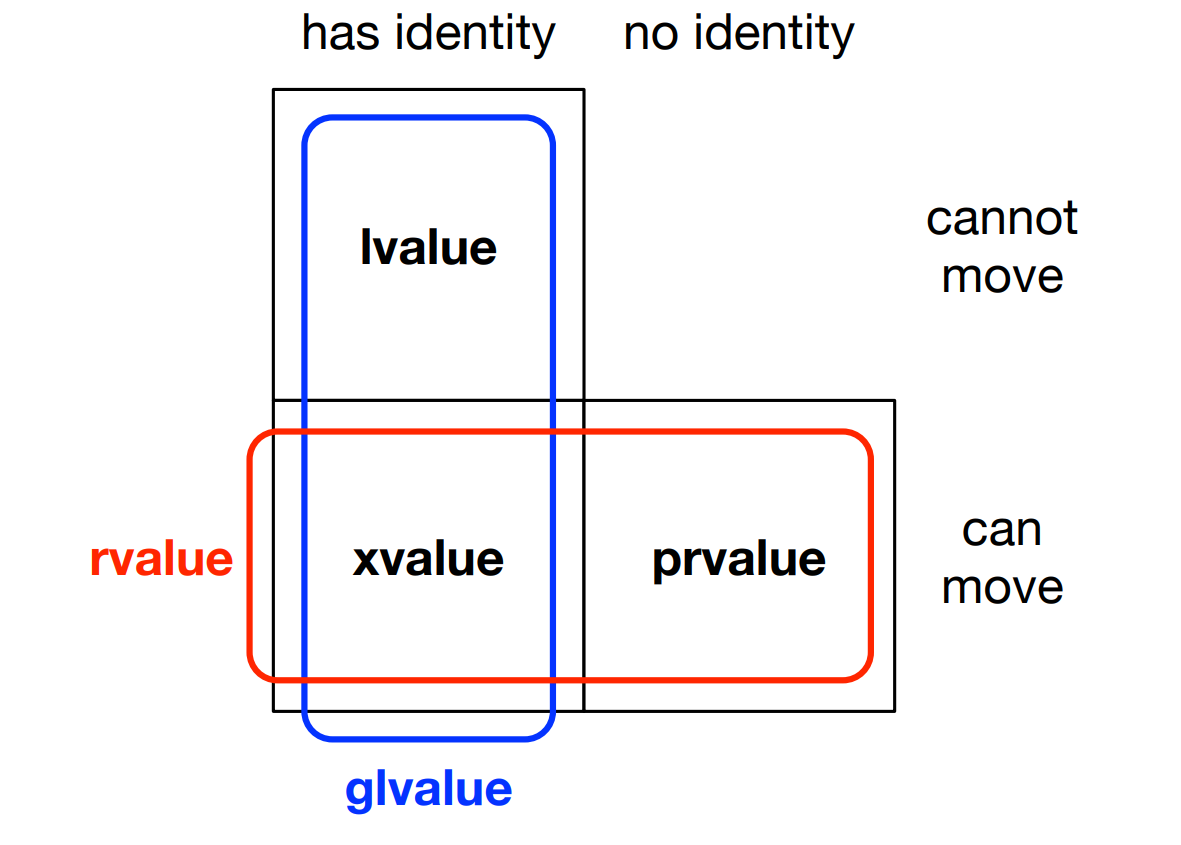
Copy elision(lvalue, rvalue)
-
glvalues identify objects
-
xvalues identify an object whose resources can be reused
int x;
f(std::move(x))
- prvalues compute the value of an operand or initialize an object
Compilers have to omit copy/move construction of class objects under certain circumstances:
- in a return statement, when the operand is a prvalue of the same class type as the function return type:
T f() {
    return T();
}

f(); // only one call to default constructor of T

T x = T{T{f()}}; // only one call to default constructor of T
Ownership semantics
a resource should be owned (encapsulated) by exactly one object at all times, ownership can only be transferred explicitly by moving the respective object
- always use ownership semantics when managing resources in C++ (such as memory, file handles, sockets etc.)!
Smart pointer
unique pointer
-
std::unique_ptris a smart pointer implementing ownership semantics for arbitrary pointers -
assumes unique ownership of another object through a pointer
- automatically disposes of that object when
std::unique_ptrgoes out of scope - a
std::unique_ptrcan be used (almost) exactly like a raw pointer, but it can only be moved, not copied - a
std::unique_ptrmay be empty
ALWAYS use std::unique_ptr over raw pointers!
creation:
std::make_unique<type>(arg0, ..., argN)
- the
get()member function returns the raw pointer release()member function returns the raw pointer and releases ownership(very rarely required)
struct A{
    int a;
    int b;

    A(int aa, int bb) : a{aa},b{bb} {}
};

void foo(std::unique_ptr<A> aptr) // assume ownership
    // do sth
}

void bar(const A& a) { // does not assume ownership
    /* do something */
}

int main() {
    auto aptr = std::make_unique<A>(42,123);
    int a = aptr->a;
    bar(*aptr); // retain ownership
    foo(std::move(aptr)) // transfer ownership
}
array example
std::unique_ptr<int[]> foo(unsigned size) {
    auto buffer = std::make_unique<int[]>(size);
    for (unsigned i = 0; i < size; ++i)
        buffer[i] = i;
    return buffer; // transfers ownership to caller
}

auto buffer = foo(42);
Advanced example
#include <bits/stdc++.h>
#include <memory> // for std::make_unique
#include <type_traits> // for std::is_pointer_v
using namespace std;
#define _ <<" "<<
#define sz(x) ((int) (x).size())
typedef long long ll;
typedef pair<int, int> pii;
typedef vector<vector<int>> Graph;
typedef vector<vector<pair<int,ll>>> Graphl;
const int maxn = 5e5 + 5;

class A {
public:
    int a = 1;
    A() {}
    virtual ~A() {} // required!
    std::unique_ptr<A> clone() const {
        return std::unique_ptr<A>(this->cloneImpl());
    }

private:
    virtual A* cloneImpl() const = 0;
};

template <typename Derived, typename Base>
class CloneInherit : public Base {
public:
    std::unique_ptr<Derived> clone() const {
        return std::unique_ptr<Derived>(
        static_cast<Derived*>(this->cloneImpl()));
    }

private:
    virtual CloneInherit* cloneImpl() const override {
        return new Derived(static_cast<const Derived&>(*this));
    }
};

class B : public CloneInherit<B, A> {
    // nothing to be done!
public:
    int v = 1;
};


int main() {
    auto b1 = make_unique<B>();
    auto b2 = make_unique<B>();

    b2->a = 1; b2->v = 2;
    b1->a = 3; b1->v = 5;

    // from B to A
    unique_ptr<A> a1 = std::move(b1);
    auto a2 = a1->clone();

    // from A to B (2 kind)
    B* t2 = dynamic_cast<B*>(a2.release());
    unique_ptr<B> ut(dynamic_cast<B*>(a1.release()));

    cout << t2->a _ t2->v << endl;
    delete t2; // delete
    return 0;
}
shared pointer
std::shared_ptr is a smart pointer implementing shared ownership
- a resource can be simultaneously shared with several owners
- the resource will only be released once the last owner releases it
- multiple
std::shared_ptrobjects can own the same raw pointer, implemented through reference counting - a
std::shared_ptrcan be copied and moved
use std::make_shared for creation
to break cycles, you can use std::weak_ptr
#include <memory>
#include <vector>

struct Node {
    std::vector<std::shared_ptr<Node>> children;

    void addChild(std::shared_ptr<Node> child);
    void removeChild(unsigned index);
};

int main() {
    Node root;
    root.addChild(std::make_shared<Node>());
    root.addChild(std::make_shared<Node>());
    root.children[0]->addChild(root.children[1]);

    root.removeChild(1); // does not free memory yet
    root.removeChild(0); // frees memory of both children
}
guidline:
std::unique_ptrshould almost always be passed by value- raw pointers represent resourcesraw pointers represent resources
- references grant temporary access to an object without assuming ownership
struct A { };

// reads a without assuming ownership
void readA(const A& a);
// may read and modify a but does not assume ownership
void readWriteA(A& a);
// works on a copy of A
void workOnCopyOfA(A a);
// assumes ownership of A
void consumeA(A&& a);

int main() {
    A a;

    readA(a);
    readWrite(a);
    workOnCopyOfA(a);
    consumeA(std::move(a)); // cannot call without std::move
}
DO NOT DO:
int* i;
*i = 5; // OUCH: writing to random memory location

void f() {
    int* i = new int{5};
    // ... use i ...
} // OUCH: memory of i not freed, memory leak!

int* i = new int{5};
// ... use i ...
delete i;
delete i; // OUCH: freeing already freed pointer, undefined

void f(int* i) {
    *i = 5; // OUCH: i might be nullptr
}

f(nullptr); // OUCH: this might crash or worse..

int *i = new int[5] {1, 2, 3, 4, 5};
int *j = i; // i and j now point to same location

*j = 10; // ok, i[0] is now 10
*j++ = 11; // ok, i[0] is now 11, j points to i[1]
*(++j) = 12; // ok, i[2] is now 12, j points to i[2]
*(j + 10) = 13; // OUCH: overwriting something unrelated to i/j
OOP2
Derived Class
any class type (struct or class) can be derived from one or several base classes
class class_name : base_specifier_list {
    member_specification
};
base specifier list
access_specifier virtual_specifier base_class_name
example
class Base {
    int a;
};

class Derived0 : public Base {
    int b;
};

class Derived1 : private Base {
    int c;
};

// multiple inheritance: avoid if possible
class Derived2 : public virtual Base, private Derived1 {
    int d;
};
constructor
struct Base {
    int a;

    Base() : a{42} { std::cout << "Base::Base()\n"; }
    explicit Base(int av) : a{av} {
        std::cout << "Base::Base(int)\n";
    }
};

struct Derived : Base {
    int b;

    Derived() : b{42} { std::cout << "Derived::Derived()\n"; }
    Derived(int av, int bv) : Base(av), b{bv} {
        std::cout << "Derived::Derived(int, int)\n";
    }
};

int main() {
    Derived derived0;
    Derived derived1(123, 456);
}
// output
// Base::Base()
// Derived::Derived()
// Base::Base(int)
// Derived::Derived(int, int)
deconstructor
struct Base0 {
    ~Base0() { std::cout << "Base0::~Base0()\n"; }
};

struct Base1 {
    ~Base1() { std::cout << "Base1::~Base1()\n"; }
};

struct Derived : Base0, Base1 {
    ~Derived() { std::cout << "Derived::~Derived()\n"; }
};
int main() {
    Derived derived;
}
// output
// Derived::~Derived()
// Base1::~Base1()
// Base0::~Base0()
qualified look up
struct A {
    void a();
};

struct B : A {
    void a();
};

int main {
    B b;
    b.a(); // calls B::a()
    b.A::a(); // calls A::a()
}
inheritance mode
- public means the public base class members are public, and the protected members are protected
- protected means the public and protected base class members are only accessible for class members / friends of the derived class and its derived classes
- private means the public and protected base class members are only accessible for class members / friends of the derived class
Virtual function and polymorphy
inheritance in C++ is by default non-polymorphic, the type of the object determines which member is referred to
struct Base {
    void foo() { std::cout << "Base::foo()\n"; }
};

struct Derived : Base {
    void foo() { std::cout << "Derived::foo()\n"; }
};

int main() {
    Derived d;
    Base& b = d; // works, Derived IS-A Base

    d.foo(); // prints Derived::foo()
    b.foo(); // prints Base::foo()
}
virtual function
non-static member functions can be marked virtual, a class with at least one virtual function is polymorphic
- only the function in the base class needs to be marked virtual, the overriding functions in derived classes do not need to be (and should not be) marked
virtual - instead they are marked
override
struct Base {
    virtual void foo() { std::cout << "Base::foo()\n"; }
};

struct Derived : Base {
    void foo() override { std::cout << "Derived::foo()\n"; }
};

int main() {
    Base b;
    Derived d;
    Base& br = b;
    Base& dr = d;

    d.foo(); // prints Derived::foo()
    dr.foo(); // prints Derived::foo()
    d.Base::foo(); // prints Base::foo()
    dr.Base::foo(); // prints Base::foo()

    br.foo(); // prints Base::foo()
}
with override
struct Base {
    virtual void foo(int i);
    virtual void bar();
};

struct Derived : Base {
    void foo(float i) override; // ERROR: does not override foo(int)
    void bar() const override; // ERROR: does not override bar()
};
to prevent overriding a function it can be marked as final:
struct Base {
    virtual void foo() final;
};

struct Derived : Base {
    void foo() override; // ERROR: overriding final function
};

struct Base final {
    virtual void foo();
};

struct Derived : Base { // ERROR: deriving final class
    void foo() override;
};
Virtual deconstructor
- derived objects can be deleted through a pointer to the base class, this leads to undefined behavior unless the destructor in the base class is virtual
- hence, the destructor in a base class should either be protected and non-virtual or public and virtual (this should be the default)
struct Base {
    virtual ~Base() {}
};

struct Derived : Base { };

int main() {
    Base* b = new Derived();
    delete b; // OK thanks to virtual destructor
    // but in general: don't use naked pointers/new/delete!
}
Slicing
inheritance hierarchies need to be handled via references (or pointers)!
struct A {
    int x;
};

struct B : A {
    int y;
};

void f() {
    B b;
    A a = b; // a will only contain x, y is lost
}
another example
struct A {
    int x;
};

struct B : A {
    int y;
};

void g() {
    B b1;
    B b2;

    A& ar = b2;
    ar = b1; // b2 now contains a mixture of b1 and b2!!!, x changed, y not change
}
in most of the cases you should then = delete all copy/move operations to prevent slicing
class BaseOfFive {
public:
    virtual ~BaseOfFive() = default; // = {}
    BaseOfFive(const BaseOfFive&) = delete;
    BaseOfFive(BaseOfFive&&) = delete;
    BaseOfFive& operator=(const BaseOfFive&) = delete;
    BaseOfFive& operator=(BaseOfFive&&) = delete;
};
to enable copying of polymorphic objects, you can define a factory method
struct A {
    A() {} // default constructor
    virtual ~A() = default; // base class with virtual destructor
    A(const A&) = delete; // prevent slicing
    A(A&&) = delete;
    A& operator=(const A&) = delete;
    A& operator=(A&&) = delete;

    virtual std::unique_ptr<A> clone () { return /* A object */; }
};

struct B : A {
    std::unique_ptr<A> clone() override { return /* B object */; }
};

auto b = std::make_unique<B>();
auto a = b->clone(); // cloned copy of b
convert
to convert references (or pointers) in an inheritance hierarchy in a safe manner, you can use
dynamic_cast< new_type > ( expression )
example
struct A {
    virtual ~A() = 0; // make class abstract
};
struct B : A{
    void foo() const;
}
struct C : A{
    void bar() const;
}

void baz(const A* aptr) {
    if (auto bptr = dynamic_cast<const B*>(aptr)) {
        bptr->foo();
    } else if (auto cptr = dynamic_cast<const C*>(aptr)) {
        cptr->bar();
    }
}
- polymorphism does not come for free, it has overhead! Implementation:vtable
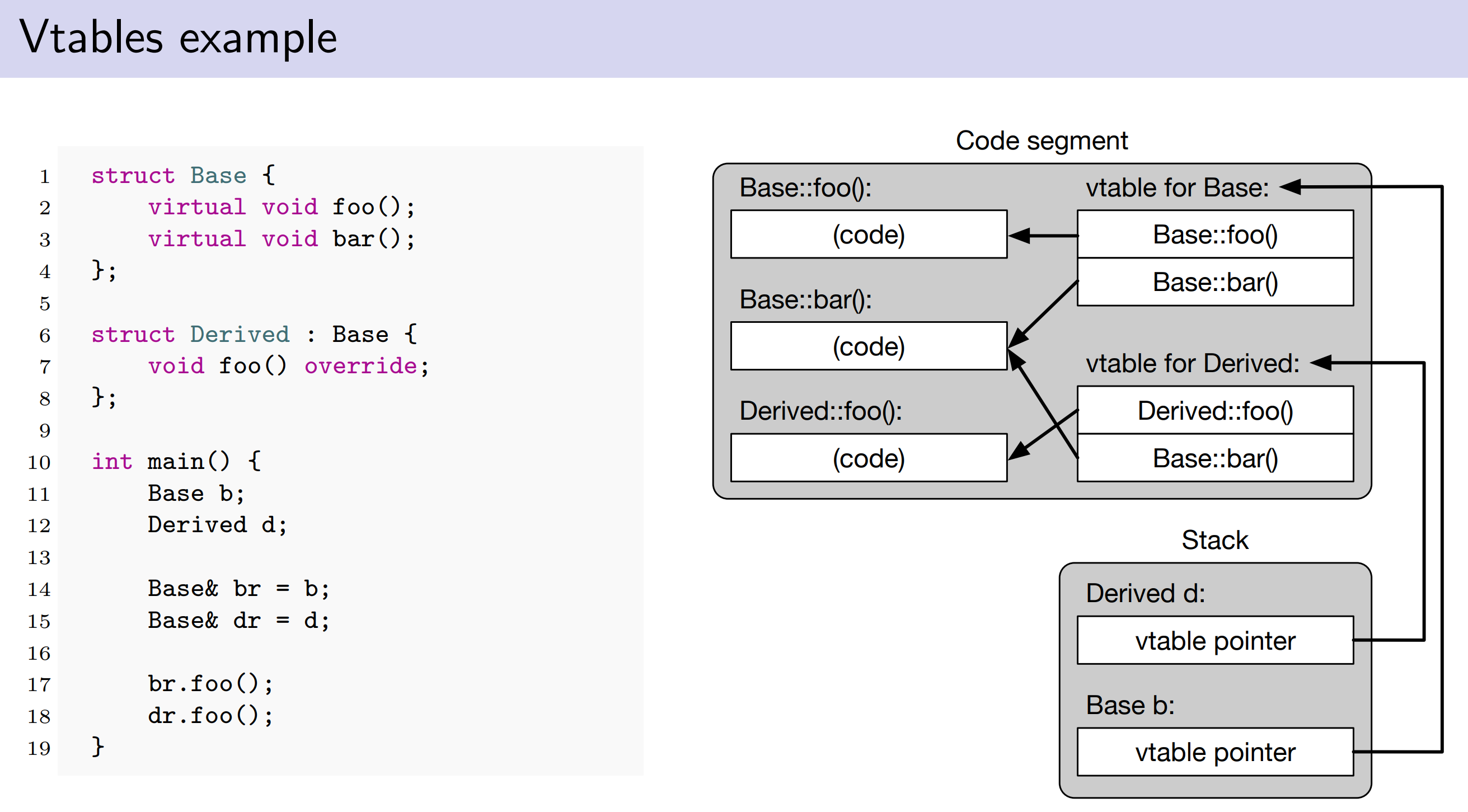
- run-time cost,each virtual function call has to: follow the pointer to the vtable, follow the pointer to the actual function
- memory cost,polymorphic objects have larger size, as they have to store a pointer to the vtable
Pure virtual function
a virtual function can be marked as a pure virtual function by adding= 0at the end of the declarator/specifiers
abstract classes are special:
- they cannot be instantiated
- but they can be used as a base class (defining an interface)
-
references (and pointers) to abstract classes can be declared
-
caution: calling a pure virtual function in the constructor or destructor of an abstract class is undefined behavior!
The destructor can be marked as pure virtual
- useful when class needs to be abstract, but has no suitable functions that could be declared pure virtual
struct Base {
    virtual ~Base() = 0;
};

Base::~Base() {}

int main() {
    Base b; // ERROR: Base is abstract
}
shared from this
when you want to create std::shared_ptr of the class you are currently in, i.e. from this, you need to be careful
struct S : std::enable_shared_from_this<S> {
    std::shared_ptr<S> notDangerous() { return shared_from_this(); }
};

int main() {
    std::shared_ptr<S> sp1{std::make_shared<S>()};
    std::shared_ptr<S> sp2 = sp1->notDangerous();
    // all is good now!
}
caveat: this only works correctly if shared_from_this is called on an object that is already owned by a std::shared_ptr!
Concept of generic programming
template declaration syntax:
template < parameter_list > declaration
parameter_list is a comma-separated list of template parameters
- type template parameters
- non-type template parameters
- template template parameters
template <typename T, unsigned N>
class Array {
    T storage[N];

public:
    T& operator[](unsigned i) {
        assert(i < N);
        return storage[i];
    }
};
template of template
template <template <class, unsigned> class ArrayType>
class Foo {
    ArrayType<int, 42> someArray;
};
template parameters with default values cannot be followed by template parameters without default values
template arguments for template template arguments must name a class template or template alias
#include <array>

template <typename T, unsigned long N>
class MyArray { };

template <template <class, unsigned long> class Array>
class Foo {
    Array<int, 42> bar;
};

int main() {
    Foo<MyArray> foo1;
    Foo<std::array> foo2;
}
alias template
namespace something::extremely::nested {

    template <typename T, typename R>
    class Handle { };

} // end namespace something::extremely::nested


template <typename T>
using Handle = something::extremely::nested::Handle<T, void*>;

int main() {
    Handle<int> handle1;
    Handle<double> handle2;
}
template instantiation
explicitly force instantiation of a template specialization
template class template_name < argument_list >;
template struct template_name < argument_list >;
template ret_type name < argument_list > (param_list); // function
example
template <typename T>
struct A {
    T foo(T value) { return value + 42; }

    T bar() { return 42; }
};

template <typename T>
T baz(T a, T b) {
    return a * b;
}

// explicit instantiation of A<int>
template struct A<int>;

// explicit instantiation of baz<float>
template float baz<float>(float, float);
Implicit template instantiation:
template <typename T>
struct A {
    T foo(T value) { return value + 42; }

    T bar();
};

int main() {
    A<int> a; // instantiates only A<int>
    int x = a.foo(32); // instantiates A<int>::foo

    // note: no error, even though A::bar is never defined

    A<float>* aptr; // does not instantiate A<float>!
}
Out of line definition
template <typename T>
struct A {
    T value;

    A(T v);

    template <typename R>
    R convert();
};

template <typename T> // out-of-line definition
A<T>::A(T v) : value{v} {}

template <typename T>
template <typename R> // out-of-line definition
R A<T>::convert() { return static_cast<R>(value); }
Disambiguator
if such a name should be considered as a type, the typename disambiguator has to be used
struct A {
    using MemberTypeAlias = float;
};

template <typename T>
struct B {
    using AnotherMemberTypeAlias = typename T::MemberTypeAlias;
};

int main() {
    B<A>::AnotherMemberTypeAlias value = 42.0f; // value is type float
}
if such a name should be considered as a template name, the template disambiguator has to be used
template <typename T>
struct A {
    template <typename R>
    R convert() { return static_cast<R>(42); }
};

template <typename T>
T foo() {
    A<int> a;

    return a.template convert<T>();
}
reference collapsing
template <typename T>
class Foo {
    using Trref = T&&;
};

int main() {
    Foo<int&&>::Trref x; // what is the type of x?
}
- rvalue reference to rvalue reference collapses to rvalue reference
- any other combination forms an lvalue reference
Template specialization
general
template <> declaration
example
template <typename T>
class MyContainer {
/* generic implementation */
};

template <>
class MyContainer<long> {
/* specific implementation for long */
};

int main() {
    MyContainer<float> a; // uses generic implementation
    MyContainer<long> b; // uses specific implementation
}
Partial specialization
template <typename C, typename T>
class SearchAlgorithm {
    void find(const C& container, const T& value) {
    /* do linear search */
    }
};

template <typename T>
class SearchAlgorithm<std::vector<T>, T> {
    void find(const std::vector<T>& container, const T& value) {
    /* do binary search */
    }
};
Template argument deduction
template <typename T>
void swap(T& a, T& b);

int main() {
    int a{0};
    int b{42};

    swap(a, b); // T is deduced to be int
}
sometimes ambigouus
template <typename T>
T max(const T& a, const T& b);

int main() {
    int a{0};
    long b{42};

    max(a, b); // ERROR: ambiguous deduction of T
    max(a, a); // ok
    max<int>(a, b); // ok
    max<long>(a, b); // ok
}
class deduction
#include <vector>

int main() {
    std::vector v1{42}; // vector<int> with one element
    std::vector v2{v1}; // v2 is also vector<int>
    // and not vector<vector<int>>
}
deduction guide
using namespace std::string_literals;

template <typename T1, typename T2>
struct MyPair {
    T1 first;
    T2 second;
    MyPair(const T1& x, const T2& y) : first{x}, second{y} {}
};

// deduction guide for the constructor:
template <typename T1, typename T2>
MyPair(T1, T2) -> MyPair<T1, T2>;

int main() {
    MyPair p1{"hi"s, "world"s}; // pair of std::string
}
stl
// let std::vector<> deduce element type from initializing iterators:
namespace std {
    template <typename Iterator>
    vector(Iterator, Iterator)
        -> vector<typename iterator_traits<Iterator>::value_type>;
}

// this allows, for example:
std::set<float> s;
// ... fill s ...
std::vector v(s.begin(), s.end()); // OK, std::vector<float>
auto
auto does not require any modifiers to work, however, it can make code hard to understand and error prone, so all known modifiers should always be added to auto
const int* foo(); // using raw pointers for illustrative purposes only

int main() {
    // BAD:
    auto f1 = foo(); // auto is const int*
    const auto f2 = foo(); // auto is int*
    auto* f3 = foo(); // auto is const int

    // GOOD:
    const auto* f4 = foo(); // auto is int
}
auto is not deduced to a reference type,
this might incur unwanted copies, so always add all known modifiers to auto
struct A {
    const A& foo() { return *this; }
};

int main() {
    A a;
    auto a1 = a.foo(); // BAD: auto is const A, copy
    const auto& a2 = a.foo(); // GOOD: auto is A, no copy
}
template lambda
// generic lambda:
auto sumGen = [](auto x, auto y) { return x + y; };

// templated lambda:
auto sumTem = []<typename T>(T x, T y) { return x + y; };
in fact, since C++20, also ordinary functions can take auto parameters as well:
void f1(auto x) { /* ... */ }
this automatically translates into a function template with an invented template parameter for each auto parameter
Parameter pack
parameter packs are template parameters that accept zero or more arguments
- non-type:
type ... Args - type:
typename|class ... Args - template:
template < param_list > typename|class ... Args
// a variadic class template with one parameter pack
template <typename... T>
struct Tuple { };

// a variadic function template, expanding the pack in its argument
template <typename... T>
void printTuple(const Tuple<T...>& tuple);

// a variadic function template with a function parameter pack
template <typename... T>
void printElements(const T&... args);

int main() {
    Tuple<int, int, float> tuple;

    printTuple(tuple);
    printElements(1, 2, 3, 4);
}
example
#include <iostream>

void printElements() { std::println(""); }

template <typename Head, typename... Tail>
void printElements(const Head& head, const Tail&... tail) {
    std::print("{}", head);

    if constexpr (sizeof...(tail) > 0)
        std::print(", ");

    printElements(tail...);
}

int main() {
    printElements(1, 2, 3.0, 3.14, 4);
}
fold expression
fold expressions can be used to reduce a parameter pack over a binary operatorop
- variant 1 (unary left): ( ... op pack )
- variant 2 (unary right): ( pack op ... )
- variant 3 (binary left): ( init op ... op pack )
- variant 4 (binary right): ( pack op ... op init )
- pack must be an expression containing an unexpanded parameter pack
- init must be an expression not containing a parameter pack
semantics:
- \((\ldots \circ E)\) becomes \(\left(\left(E_1 \circ E_2\right) \circ \ldots\right) \circ E_n\)
- \((E \circ \ldots)\) becomes \(E_1 \circ\left(\ldots\left(E_{n-1} \circ E_n\right)\right)\)
- \((I \circ \ldots \circ E)\) becomes \(\left(\left(\left(I \circ E_1\right) \circ E_2\right) \circ \ldots\right) \circ E_n\)
- \((E \circ \ldots \circ I)\) becomes \(E_1 \circ\left(\ldots\left(E_{n-1} \circ\left(E_n \circ I\right)\right)\right)\)
unary fold:
template <typename R, typename... Args>
R reduceSum(const Args&... args) {
    return (args + ...);
}

int main() {
    return reduceSum<int>(1, 2, 3, 4); // returns 10
}
binary fold:
template <typename... T>
void print(const T&... args) {
    (std::cout << ... << args) << '\n';
}

int main() {
    print(); // prints nothing
    print(1); // prints "1\n"
    print(1, 2, 3); // prints "123\n"
}
previous print
#include <iostream>

template <typename Head, typename... Tail>
void printElements(const Head& head, const Tail&... tail) {
    std::print("{}", head);

    // generic lambda
    auto outWithComma = [](const auto& arg) { std::print(", {}", arg); };

    (..., outWithComma(tail) ); // unary fold expression with comma operator

    std::println("");
}

int main() {
    printElements(1, 2, 3.0, 3.14, 4);
}
Compile-time programming
- const: do not modify this object in this scope (variables, member functions)
- constexpr: something that can be evaluated at compile-time
the keyword constexpr declares a variable or function to be able to be evaluated at compile-time
constexpr variables must be
- of literal type (e.g. scalar, reference, or user-defined type with constexpr constructor/destructor)
- immediately initialized with a constant expression
constexpr functions must
- have literal return types and arguments
- not contain things like goto or variable definitions of non-literal types or static/thread storage duration
int f(int x) { return x * x; }

constexpr int g(int x) { return x * x; }

int main() {
    const int x{7}; // constant expression
    const int y = f(x); // not a constant expression!
    const int z = g(x); // constant expression

    constexpr int xx{x}; // ok
    constexpr int yy{y}; // ERROR: f(x) not constant expression
    constexpr int zz{z}; // ok
}
function
constexpr functions are like regular functions, except they cannot have side effects
- since C++20, exceptions and exception handling may be used
to make your user-defined type (class) a literal type, it needs
- a constexpr destructor (or trivial before C++20)
- to have at least one constexpr constructor (that is not copy/move), or it could be an aggregate type
if you want the member function to be const, you have to additionally declare it as such
struct A {
    constexpr void myFunc() const;
};
constexprfunctions can still be called at run-time
if you want guaranteed execution at compile-time, C++20 introduced the consteval keyword to enable immediate functions
consteval int sqr(int n) {
    return n * n;
}
example:
int sqrRunTime(int n) { return n * n; }

consteval int sqrCompileTime(int n) { return n * n; }

constexpr int sqrRunOrCompileTime(int n) { return n * n; }

int main() {
    constexpr int p1 = sqrRunTime(100); // ERROR: not constexpr
    constexpr int p2 = sqrCompileTime(100);
    constexpr int p3 = sqrRunOrCompileTime(100);

    int x{100};
    int p4 = sqrRunTime(x);
    int p5 = sqrCompileTime(x); // ERROR: x not constant expression
    int p6 = sqrRunOrCompileTime(x);

    int p7 = sqrCompileTime(100); // compile-time
    int p8 = sqrRunOrCompileTime(100); // run-time or compile-time
}
if
with if constexpr we can evaluate conditions at compile-time
#include <iostream>
#include <memory> // for std::make_unique
#include <type_traits> // for std::is_pointer_v

template <typename T>
auto getValue(T t) {
    if constexpr (std::is_pointer_v<T>)
        return *t; // deduces return type to int for T = int*
    else
        return t; // deduces return type to int for T = int
}

int main() {
    int i{9};
    auto j = std::make_unique<int>(9);

    std::cout << getValue(i) << "\n"; // output "9"
    std::cout << getValue(j.get()) << "\n"; // output "9"
}
for return
#include <functional> // for std::forward
#include <type_traits> // for std::is_same and std::invoke_result

template <typename Callable, typename... Args>
auto call(Callable op, Args&&... args) {
    if constexpr (std::is_void_v<std::invoke_result_t<Callable, Args...>>) {
        // return type is void:
        op(std::forward<Args>(args)...);
        // do something before we return
        return;
    }
    else { // return type is not void:
        auto retValue{op(std::forward<Args>(args)...)};
        // do something with retValue before we return
        return retValue;
    }
}
C++23 introduced another if statement: if consteval
syntax:if consteval { /* A */ } else { /* B */ }
- no condition
- mandatory braces
- else branch is optional
consteval int f(int i) { return i; }

constexpr int g(int i) {
    if consteval {
        return f(i) + 1; // const-evaluated context
    }
    else {
        return 42;
    }
}

consteval int h(int i) {
    return f(i) + 1; // const-evaluated context due to consteval
}
by default, lambdas are implicitly constexpr if possible
auto squared = [] (auto x) { return x * x; } ;

std::array<int, squared(5)> a; // ok, std::array<int, 25>,
 // as squared(5) is constexpr
to ensure that a lambda is constexpr, you can declare it as constexpr after the argument list, before the optional trailing return type
auto squared2 = [] (auto x) constexpr { return x * x; };
auto squared3 = [] (int x) constexpr -> int { return x * x; };
Template meta programming3
template <unsigned N>
struct Factorial {
    static constexpr unsigned value = N * Factorial<N-1>::value;
};

template <>
struct Factorial<0> {
    static constexpr unsigned value = 1;
};

int main() {
    return Factorial<5>::value; // computes 5! at compile-time
}
using function
#include <iostream>

template <unsigned N>
constexpr unsigned fibonacci() {
    return fibonacci<N-1>() + fibonacci<N-2>();
}

template <>
constexpr unsigned fibonacci<1>() { return 1; }

template <>
constexpr unsigned fibonacci<0>() { return 0; }

int main() {
    std::cout << fibonacci<10>() << "\n"; // computes compile-time
}
using if constexpr
template <unsigned N>
constexpr unsigned fibonacci() {
    if constexpr (N >= 2)
        return fibonacci<N-1>() + fibonacci<N-2>();
    else
        return N;
}
static assert
checks assertions at compile-time
static_assert ( bool_constexpr, message )
static_assert ( bool_constexpr )
Type traits
make your own type traits
template <typename T>
struct IsUnsigned {
    static constexpr bool value = false;
};

template <>
struct IsUnsigned <unsigned char> {
    static constexpr bool value = true;
};
/* add further specializations for all other unsigned types... */
template <typename T>
void foo() {
    // make sure template argument is unsigned
    static_assert(IsUnsigned<T>::value);
}
from std:
std::is_integral, std::is_function, is_lvalue_referenceis_polymorphic, is_signed, is_aggregateis_move_constructible, has_virtual_destructoris_same, is_base_of, is_invocableremove_const, make_signed, common_type
enable if
check if T is calcable
template <typename T,
typename std::enable_if<std::is_arithmetic_v<T>,
    bool>::type = true>
T f(T t) { return 2*t; }
or
template <typename T,
    typename = std::enable_if_t<std::is_arithmetic_v<T>>>
T f(T t) { return 2*t; }
check if all same type
// check if passed types are homogeneous
template <typename T1, typename... TN>
struct IsHomogeneous {
    static constexpr bool value = (std::is_same_v<T1,TN> && ...);
};

// check if passed parameters have same type
template <typename T1, typename... TN>
constexpr bool isHomogeneous(T1, TN...) {
    return (std::is_same_v<T1,TN> && ...);
}
int main() {
    std::cout << IsHomogeneous<int, std::size_t>::value << "\n"; // outputs "0\n"
    std::cout << isHomogeneous(43, -1) << "\n"; // outputs "1\n"
}
using c++20 concept
#include <concepts>

template <typename T>
requires std::integral<T>
T gcd1(T a, T b)
{ if (b==0) return a; else return gcd1(b, a%b); }

template <typename T>
T gcd2(T a, T b) requires std::integral<T>
{ if (b==0) return a; else return gcd2(b, a%b); }

template <std::integral T>
T gcd3(T a, T b)
{ if (b==0) return a; else return gcd3(b, a%b); }

std::integral auto gcd4(std::integral auto a, std::integral auto b)
{ if (b==0) return a; else return gcd4(b, a%b); }
Expression template
- instead of evaluating each intermediate step into a temporary, build an expression tree
- only when assigning the result, perform the actual computation by traversing the expression tree
- also known as lazy evaluation
using add = /* ... */;
using mul = /* ... */;

template <typename op, typename... operands>
class Expr { /* ... */ };

Expr<add, vector, vector>
operator+(const vector& lhs, const vector& rhs);

Expr<mul, double, vector>
operator*(double lhs, const vector& rhs);
then
// all temporaries in one step:
Expr<add,
Expr<mul, double, vector>,
Expr<mul, double, vector>> z3 = c1 * x + c2 * y;
// auto z3 = ...; would be more concise (but hide the expression tree)

// all computations done in assignment:
vector z = z3;
implementation
template <typename op, typename... operands>
class Expr {
    op callable_;
    std::tuple<const operands&...> args_;

public:
    Expr(op callable, const operands&... args)
        : callable_{callable}, args_{args...} {}
};
operator
template <typename LHS, typename RHS>
auto operator*(const LHS& lhs, const RHS& rhs) {
    return Expr{
        [] (auto const& l, auto const& r) {
        return l * r; },
        lhs, rhs
    };
}
assginment
class vector {
    std::vector<double> v_;

public:
    // ...

    template <typename srctype>
    vector& operator=(const srctype& src) {
        for (unsigned i = 0; i < v_.size(); ++i)
            v_[i] = src[i];

        return *this;
    }
};
subscript
template <typename operand>
auto subscript(const operand& v, unsigned i) {
    if constexpr (is_vector_or_expression<operand>) {
        return v[i];
    }
    else {
        return v;
    }
}

template <typename op, typename... operands>
class Expr {
    op callable_;
    std::tuple<const operands&...> args_;

public:
    //...
    auto operator[](unsigned i) const {
        const auto call_at_index =
            [this, i](const operands&... a) {
                return callable_(subscript(a,i)...);
            };
        return std::apply(call_at_index, args_);
    }
};
type trais
template <typename>
struct is_vector : std::false_type {};

template <>
struct is_vector<vector> : std::true_type {};

template <typename>
struct is_expression : std::false_type {};

template <typename op, typename... operands>
struct is_expression<Expr<op, operands...>> : std::true_type {};

template <typename T>
constexpr bool is_vector_or_expression
    = is_vector<T>() || is_expression<T>();
more careful
template <typename LHS, typename RHS>
    requires(is_binary_op_ok<LHS, RHS>)
auto operator*(const LHS& lhs, const RHS& rhs) { /* ... */ }

template <typename T>
constexpr bool is_arithmetic = std::is_arithmetic_v<T>;

template <typename LHS, typename RHS>
constexpr bool is_binary_op_ok =
    (is_vector_or_expression<LHS> && is_vector_or_expression<RHS>)
    || (is_vector_or_expression<LHS> && is_arithmetic<RHS>)
    || (is_arithmetic<LHS> && is_vector_or_expression<RHS>);
Curiously Recurring Template Pattern (CRTP)
template <typename T>
class Base {
    // ...
};

class Derived : public Base<Derived> {
    // ...
};
do something
template <typename T>
class Base {
    public:
    void doSomething() {
        T& derived = static_cast<T&>(*this);
        // use derived somehow
    }
};
while CRTP works, it is tricky to use and can lead to insidious errors
- for example: since there are no virtual functions, there is no overriding
- instead, methods of the same name in the derived class will simply hide base class methods!
anothor example
template <typename T>
class Amount {
public:
    double getValue() const {
        return static_cast<const T&>(*this).getValue();
    }
};

class Constant42 : public Amount<Constant42> {
public:
    double getValue() const { return 42; }
};
in cpp
template <typename T>
concept HasValue = requires(T t) {
    { t.getValue() } -> std::convertible_to<double>;
}; // see later for details on concepts

template <HasValue T>
struct Amount : public T {};
polymorphic cloneing
class Cloneable {
public:
    virtual ~Cloneable() {} // required!

    std::unique_ptr<Cloneable> clone() const {
        return std::unique_ptr<Cloneable>(this->cloneImpl());
    }

private:
    virtual Cloneable* cloneImpl() const = 0;
};

template <typename Derived, typename Base>
class CloneInherit : public Base {
public:
    std::unique_ptr<Derived> clone() const {
        return std::unique_ptr<Derived>(
        static_cast<Derived*>(this->cloneImpl()));
    }

private:
    virtual CloneInherit* cloneImpl() const override {
        return new Derived(static_cast<const Derived&>(*this));
    }
};

class Concrete : public CloneInherit<Concrete, Cloneable> {
    // nothing to be done!
};

int main() {
    auto c = std::make_unique<Concrete>();
    auto cc = c->clone();

    std::cout << "cc is a " << typeid(cc).name() << "\n";
}
Concept of parallel
unsynchronized accesses (data races), deadlocks, and other potential issues when using threads are undefined behavior!
void foo(int a, int b);

// start a thread that calls foo(123, 456)
std::thread t1(foo, 123, 456);

// also works with lambdas
std::thread t2([] { foo(123, 456); } );

// creates an object that does not refer to an actual thread
std::thread t3;
the member function join() is used to wait for a thread to finish
-
join() must be called exactly once for each thread!
-
if a thread was not joined and the std::thread destructor is called, the program is terminated
alternatively, you can call detach() to have the thread execute independently from its creator
C++20 adds std::jthread, a joining thread
std::jthread t1([] { std::cout << "Hi!\n"; });
// automatically joins when going out of scope

{
    std::jthread t2([] {});
}
7 // OK, t2 joined when going out of scope
additionally it supports interruption signaling via std::stop_token
std::thread and std::jthread are not copyable, but they can be moved
std::thread t1([] { std::cout << "Hi!\n"; });
std::thread t2 = std::move(t1); // t1 now empty
t2.join(); // OK, joining the thread that started in t1 originally
can be used in container
std::vector<std::thread> threadPool;
for (int i = 1; i < 10; ++i)
    threadPool.emplace_back([i] { safe_print(i); });

for (auto& t : threadPool)
    t.join();
std::this_thread::sleep_for()stop the current thread for a given amount of timestd::this_thread::sleep_until()stop the current thread until a given point in timestd::this_thread::yield()let the operating system schedule another threadstd::this_thread::get_id()get the (operating system specific) id of the current thread
using namespace std::literals;

int main() {
    std::jthread interruptible([] (std::stop_token stoken) {
        int counter{0};
        while (true) { // infinite loop
            std::this_thread::sleep_for(0.2s);
            if (stoken.stop_requested()) return;
            std::cout << "interruptible: " << counter << "\n";
            ++counter;
        }
    });

    std::this_thread::sleep_for(1s);

    interruptible.request_stop();
    std::cout << "Main thread interrupted the jthread.\n";
}
Mutex
std::mutexfor mutual exclusionstd::recursive_mutexfor recursive mutual exclusionstd::shared_mutexfor mutual exclusion with shared locks
locking
std::unique_lockforstd::mutexstd::shared_lockforstd::shared_mutexstd::scoped_lock for deadlock free locking of several mutexes
std::mutex is an exclusive synchronization primitive
lock()locks the mutex, blocking all other threadsunlock()will unlock the mutextry_lock()tries to lock the mutex and returns true if successful
std::mutex printMutex;

void safe_print(int i) {
    printMutex.lock();
    std::cout << i << " ";
    printMutex.unlock();
}
recursive mutexes are regular mutexes that additionally allow a thread that currently holds the mutex to lock it again
std::recursive_mutex m;

void foo() {
    m.lock();
    std::cout << "foo\n";
    m.unlock();
}

void bar() {
    m.lock();
    std::cout << "bar\n";
    foo(); // this will not deadlock!
    m.unlock();
}
shared mutex
int value{0};
std::shared_mutex m;
std::vector<std::jthread> threadPool;
// add readers
for (int i = 0;i < 5; ++i) {
    threadPool.emplace_back([&]{
        m.lock_shared();
        safe_print(value);
        m.unlock_shared();
    });
}
// add writers
for (int i = 0;i < 5; ++i) {
    threadPool.emplace_back([&]{
        m.lock();
        ++value;
        m.unlock();
    });
}
std::unique_lock wraps mutexes using RAII
std::mutex m;
int i{0};

std::jthread t{[&] {
    std::unique_lock l{m}; // m.lock() is called
    ++i;
    // m.unlock() is called
}};
when using multiple mutexes, deadlocks can occur
consistent ordering avoids this
use std::scoped_lock when locking multiple mutexes in consistent order, to guarantee no deadlocks
std::mutex m1, m2, m3;
void threadA() {
    std::scoped_lock l{m1, m2, m3};
}
void threadB() {
    std::scoped_lock l{m3, m2, m1};
}
Condition
condition variables can be used to synchronize threads by waiting until an (arbitrary) condition becomes true
wait(): takes a reference to a std::unique_lock that must be locked by the caller as an argument, unlocks the mutex and waits for the condition variablenotify_one(): notify a single waiting thread, mutex does not need to be held by the callernotify_all(): notify all waiting threads, mutex does not need to be held by the caller
std::mutex m;
std::condition_variable cv;
std::vector<int> taskQueue;

void pushWork(int task) {
    {
        std::unique_lock lck{m};
        taskQueue.push_back(task);
    }
    cv.notify_one();
}
and
void workerThread() {
    std::unique_lock lck{m};
    while (true) {
        if (!taskQueue.empty()) {
            int task = taskQueue.back();
            taskQueue.pop_back();
            lck.unlock();
            // ... do actual task here
            lck.lock();
        }
        cv.wait(lck,
            []{ return !taskQueue.empty(); });
    }
}
atomic
threads can also be synchronized with atomic operations that are usually more efficient than mutexes
int a{10};
void threadA() { atomic_add(a, 1); }
void threadB() { atomic_add(a, 2); }
std::atomic<T> is a class that represents an atomic version of the type T
- T load(): loads the value
- void store(T desired): stores desired in the object
- T exchange(T desired): stores desired in the object and returns the old value
if T is an integral type, the following operations also exist:
T fetch_add(T arg): adds arg to the value and returns the old valueT operator+=(T arg): add arg to the value and returns the new value
std::atomic<int> i{0};
void workerThread() {
    i += 1; // (A)
    i -= 1; // (B)
}
void readerThread() {
    int iLocal = i.load();
    assert(iLocal == 0 || iLocal == 1); // always true!
}
copy and ref
int val{5};
int& ref = val;
std::atomic<int> notReallyRef(ref);
std::atomic_ref<int> atomicRef(ref);
++notReallyRef; // will increment only the internal copy of ref
++atomicRef; // will actually increment the referenced variable
++atomicRef;

std::cout << "ref: " << ref << "\n";
std::cout << "notReallyRef: " << notReallyRef.load() << "\n";
std::cout << "atomicRef: " << atomicRef.load() << "\n";
std::atomic_flag provides an atomic boolean with a special interface,it is guaranteed to be lock-free
- true by calling
test_and_set() - false by calling
clear()
test() returns the current value
STL algo
std::vector<int> v{1, 2, 3, 4, 5, 6, 7, 8, 9};

// standard sequential sort
std::sort(v.begin(), v.end());

// sequential execution
std::sort(std::execution::seq, v.begin(), v.end());

// permitting parallel execution
std::sort(std::execution::par, v.begin(), v.end());

// permitting parallel execution and vectorized execution
std::sort(std::execution::unseq, v.begin(), v.end());
C++20 introduced many more parallel programming features
- coroutines,counting semaphores for shared resources,latches and barriers to coordinate threads
C++20 concept
concepts allow
- specifying requirements for template parameters
- overloading of functions
- specialization of class templates
template <typename T>
requires std::integral<T>
auto gcd1(T a, T b) { /* ... */ }
with a trailing requires clause:
template <typename T>
auto gcd2(T a, T b) requires std::integral<T>
{ /* ... */ }
using a constrained template parameter:
template <std::integral T>
auto gcd3(T a, T b) { /* ... */ }
using an abbreviated function template:
auto gcd4(std::integral auto a, std::integral auto b) { /* ... */ }
basically anywhere you can put auto, you can put <concept>auto instead
template <typename Iter, typename Val>
requires std::input_iterator<Iter>
&& std::equality_comparable<Value_type<Iter>, Val>
Iter find(Iter b, Iter e, Val v);
predefined concept
- same_as, derived_from, convertible_to, assignable_from, swappable
- integral, signed_integral, unsigned_integral, floating_point
- destructible, constructible_from, default_constructible, move_constructible, copy_constructible
- equality_comparable, totally_ordered
- movable, copyable, semi_regular, regular
own concept
template <template-parameter-list>
concept concept-name = constraint-expression;
example
#include <type_traits>
template <typename T>
concept Integral = std::is_integral_v<T>;
template <typename T>
concept SignedIntegral = Integral<T> && std::is_signed_v<T>;
template <typename T>
concept UnsignedIntegral = Integral<T> && !SignedIntegral<T>;
requirer expression
template <typename T>
concept Addable = requires (T a, T b) {
a + b; // two objects of type T can be added
};
type requirement
template <typename T>
concept TypeRequirement = requires {
typename T::value_type; // T has nested member value_type
typename Other<T>; // Other can be instantiated with T
};
compound req
template <typename T>
concept Equal = requires (T a, T b) {
{ a == b } -> std::convertible_to<bool>;
{ a != b } -> std::convertible_to<bool>;
};
use if
struct First {
int count() const { return 2020; }
};
struct Second {
int size() const { return 2021; }
};
template <typename T>
int getNumberOfElements(T t) {
if constexpr (requires(T t) { { t.count() } -> std::convertible_to<int>; })
return t.count();
if constexpr (requires(T t) { { t.size() } -> std::convertible_to<int>; })
return t.size();
else
return 42;
}
Short Exercise
-
write a function translate parameters to a vector, or set
-
use functional programming get primes less than
200 - how to init Vector with
Vector<double> v1{1,3,4,5}; - use variant to model a mixture of plus lambda and multiply lambda. evaluate arithmetic expression
- use varidic template implement addition of arbitary vector
OOP
- implement Polymorphic cloning demo
- Use shared pointer implement segment tree
- implement difference array and copy, extend normal array
- implement Graph, Tree, structure. find depth in complie time,given tree
- use CRPT , implment polymorhpy
Concept
- A gcd function, require the arguments to be equal and integral, 2 methods,Type traits
Parallel programming
- compute matrix multiplication, use worker and await
- A txt file contains a password
<10000use a thread to set a passswd randomly and use multithread clients to crack the password
Compile time
- use expression template to implement vector and scalar multiplication
现代C++ Volum2
SOLID principles
| 缩写 | 原则名称 | 中文名称 |
|---|---|---|
| S | Single Responsibility Principle (SRP) | 单一职责原则 |
| O | Open/Closed Principle (OCP) | 开闭原则 |
| L | Liskov Substitution Principle (LSP) | 里氏替换原则 |
| I | Interface Segregation Principle (ISP) | 接口隔离原则 |
| D | Dependency Inversion Principle (DIP) | 依赖倒置原则 |
1. Single Responsibility Principle (单一职责原则)
一个类应该只有一个引起它变化的原因。
- 每个类、模块只负责一个功能。
- 避免“上帝类” —— 什么都做,什么都知道。
- 好处:高内聚,易于修改和测试。
示例:
java复制编辑// ✅ 正确做法
class ReportGenerator { void generate() {...} }
class ReportPrinter { void print() {...} }
而不是:
java复制编辑// ❌ 错误做法:职责混杂
class ReportManager {
void generate() {...}
void print() {...}
}
2. Open/Closed Principle (开闭原则)
软件实体应对扩展开放,对修改关闭。
- 意味着你应该通过扩展功能而非修改已有代码来改变行为。
- 通常通过 抽象类或接口 + 多态 实现。
示例:
java复制编辑interface Shape { double area(); }
class Circle implements Shape { ... }
class Rectangle implements Shape { ... }
// ✅ 添加新形状无需修改旧代码,只需新增类。
3. Liskov Substitution Principle (里氏替换原则)
子类必须能够替换其父类,并确保行为一致。
- 子类不应破坏父类原有的功能。
- 若用子类替代父类导致程序错误,那就违反了该原则。
示例:
java复制编辑class Bird { void fly(); }
class Ostrich extends Bird { void fly() { throw new Exception(); } } // ❌ 不应该
// ✅ 解决方法:重新设计层次结构,分出能飞和不能飞的鸟
4. Interface Segregation Principle (接口隔离原则)
不应该强迫用户依赖它们不使用的方法。
- 将大接口拆分成更小、更专一的接口,让类只实现自己需要的功能。
- 避免“胖接口”(God Interface)。
示例:
java复制编辑interface Printer { void print(); }
interface Scanner { void scan(); }
class SimplePrinter implements Printer { ... }
5. Dependency Inversion Principle (依赖倒置原则)
高层模块不应该依赖低层模块,二者都应依赖抽象;抽象不应依赖细节,细节应依赖抽象。
- 通过依赖接口(抽象),而不是依赖具体实现。
- 使用 依赖注入(Dependency Injection) 是该原则的体现。
示例:
java复制编辑// ✅ 高层模块依赖接口,而不是具体类
interface MessageSender { void send(); }
class EmailSender implements MessageSender { ... }
class Notification {
private MessageSender sender;
public Notification(MessageSender sender) { this.sender = sender; }
}